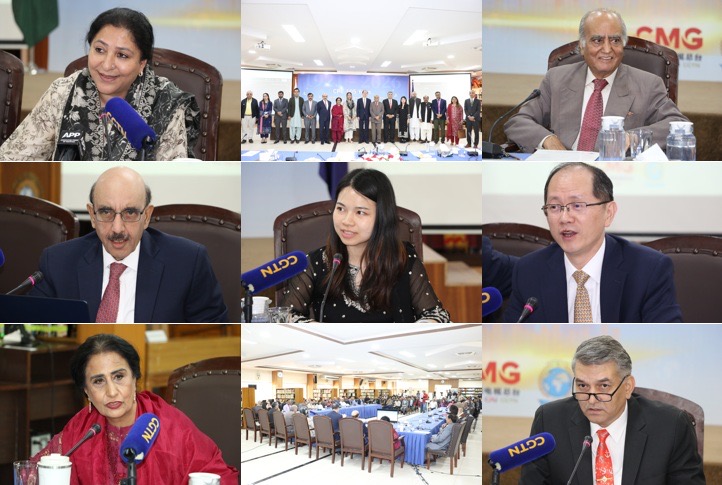
 Islamabad, July 2, 2026(Kamran Raja): The China-Pakistan Study Centre (CPSC) at the Institute of Strategic Studies Islamabad (ISSI), in collaboration with China Media Group (CMG), organized a commemorative seminar titled “CPC 105 Years: Achievements, Experiences, and the China-Pakistan Community with a Shared Future.” The event brought together senior government officials, diplomats, scholars, academics, media professionals, and students to reflect on the Communist Party of China’s (CPC) 105-year journey and its significance for Pakistan-China relations.
In his welcome address, Ambassador Khalid Mahmood, Chairman of the ISSI Board of Governors, described the CPC’s 105-year journey as a remarkable example of visionary leadership, institutional resilience, and long-term strategic planning. He said China’s achievements in economic growth, poverty reduction, technological innovation, and modernization offer valuable lessons for developing countries. He noted that Pakistan’s All-Weather Strategic Cooperative Partnership with China continues to expand into new areas, including the digital economy, artificial intelligence, green development, agricultural modernization, and human resource development under the evolving framework of CPEC.
Representing China Media Group, Ms. Wang Lei highlighted the significance of the seminar, which coincided with both the 105th anniversary of the CPC and the 75th anniversary of diplomatic relations between Pakistan and China. She reaffirmed CMG’s commitment to promoting greater understanding of China’s development experience and strengthening people-to-people exchanges between the two countries.
Addressing the seminar as Chief Guest, Minister of State for Federal Education and Professional Training Ms. Wajiha Qamar described the CPC’s development journey as an inspiring example of national rejuvenation, people-centred governance, and sustained investment in education, innovation, and human capital. She emphasized that the next phase of Pakistan-China cooperation should focus on education, scientific research, skills development, youth empowerment, and stronger collaboration among universities and research institutions.
Delivering the keynote address, former Ambassador of Pakistan to China, Ambassador Masood Khan, highlighted the CPC’s central role in China’s economic transformation, technological progress, and poverty alleviation. He described the Belt and Road Initiative as a transformative framework for international cooperation and reaffirmed Pakistan’s commitment to advancing CPEC 2.0 through expanded collaboration in industrial development, agriculture, emerging technologies, and vocational training.
Former High Commissioner of Pakistan to Australia Ambassador Naela Chohan underscored that Pakistan-China relations are founded on mutual trust, sovereign equality, and enduring friendship. She highlighted growing cooperation in artificial intelligence, the digital economy, education, healthcare, tourism, innovation, and youth exchanges, while stressing the importance of strengthening academic, media, and cultural engagement.
Dr. Abdul Wahid of the National University of Modern Languages (NUML) observed that China’s development model is built on long-term planning, continuous reform, investment in education, healthcare, infrastructure, and strong grassroots participation, all of which have contributed to sustainable economic growth and human capital development.
Guest of Honour Mr. Shi Yuanqiang, Deputy Head of Mission at the Embassy of the People’s Republic of China in Pakistan, reaffirmed China’s commitment to advancing high-quality CPEC cooperation and implementing the Action Plan for an Even Closer China-Pakistan Community with a Shared Future. He also highlighted cooperation under the Global Development, Global Security, Global Civilization, and Global Governance Initiatives.
Dr. Jibran Hussain Raza of the Public Policy Institute emphasized that China’s transformation was driven by strategic planning, institutional development, industrialization, and pragmatic reforms. He noted that Pakistan should continue strengthening its institutional and industrial capacity to maximize the opportunities presented by CPEC 2.0.
Earlier, Dr. Talat Shabbir, Director of the China-Pakistan Study Centre at ISSI, highlighted the CPC’s historic contribution to transforming China into one of the world’s leading economic and technological powers through sustained reforms, institutional resilience, and people-centred governance.
The seminar concluded with an interactive discussion on China’s modernization experience, the governance model of the Communist Party of China, and future avenues for strengthening the Pakistan-China All-Weather Strategic Cooperative Partnership.