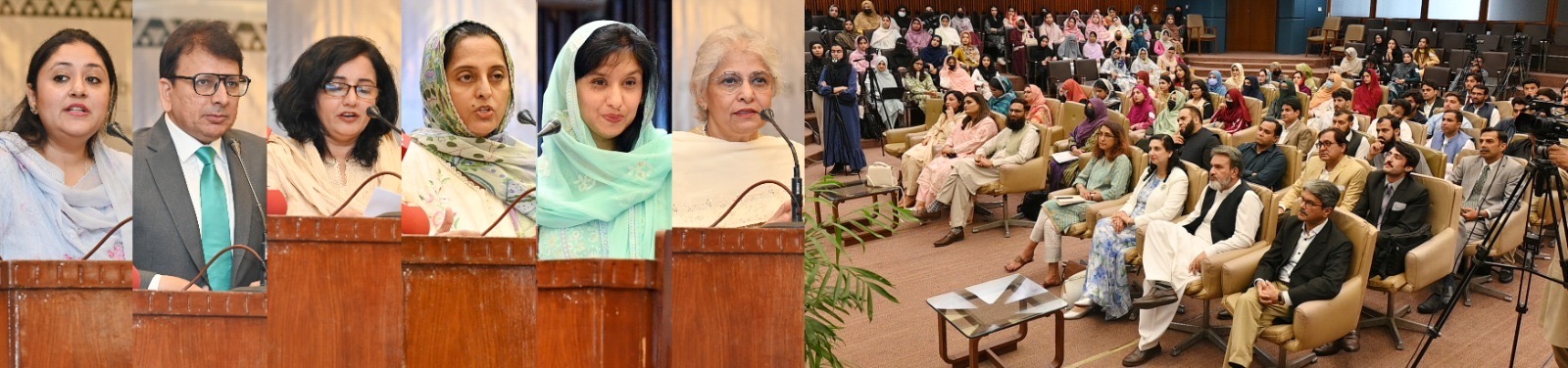
Islamabad, 05 May 2026(Kamran Raja):Scholars from four continents gathered at the International Islamic University Islamabad on Tuesday to interrogate one of academia’s most contested questions: whether decoloniality, as practised in universities today, has become the very thing it set out to dismantle.
The two-day Caliban Speaks: International Conference on Recentring Indigenous Thought in the Age of Decolonialism and Technology, hosted by IIUI’s Department of English and supported by the Higher Education Commission of Pakistan, drew academics, educators, and intellectuals from Australia, South Africa, Oman, and across Pakistan to the Allama Iqbal Auditorium at the Faisal Campus. In two days, the coferenice is witnessing four keynote addresses, eight parallel sessions, and two panel discussions unfolded, in a hybrid format that extended the conversation well beyond the auditorium’s walls.
The conference took its title from Caliban, a colonised and silenced figure of Shakespeare’s The Tempest. Prof. Dr. Najeeba Arif, Chairperson of the Pakistan Academy of Letters and the event’s Chief Guest, made that provocation explicit in her opening address. When expression is denied, she told the assembled scholars, it is tantamount to erasure. Caliban’s transformation, she argued, began the moment he chose to speak an act that was not merely communication but the assertion of existence itself. She warned, however, that the old colonial suppression of voice has found a contemporary successor in technological control, where global narratives are increasingly confined within algorithmically determined vocabularies. She urged participants to shift their focus from the language of oppression to the force of their own intellectual resolve.
In a written message delivered by Dr. Muhammad Sheeraz Dasti, IIUI President Prof. Dr. Ahmed Saad Alahmed described the university as a point of confluence where diverse cultures and intellectual traditions meet, and affirmed that a university must never produce knowledge in ways that marginalise voices outside the mainstream. Dr. Humaira Ashfaq, delivering a message on behalf of Dean Prof. Dr. Fauzia Janjua, reinforced that premise, arguing that knowledge is never neutral and that the academic community must not merely transmit it but critically reshape it.
The conference’s intellectual nerve was most visibly exposed by its convener, Dr. Asma Mansoor, whose opening remarks were as much a confession as an introduction. She told the audience she had conceived the event not from certainty but from unsettlement , a growing discomfort with what decoloniality had become in Pakistan’s academic culture. In this context, she said, the concept had been reduced to a “discursive straitjacket,” circulating within research papers and conference halls, sharpening critique, but rarely translating into anything lived or material. Invoking philosopher Rosi Braidotti, she argued that theory must function as praxis, not merely as performance. She pointed to IIUI’s own campus as a case in point: the institution houses a rich intellectual archive of Persian, Arabic, and Islamic scholarship that most of its own scholars, she observed, neither access nor know exists. Technology, she added, offered no easy escape, AI systems, far from being neutral tools, remain deeply entangled with capitalism and epistemic extraction, as recent controversies within the industry had made plain.
Co-convener Dr. Saiyma Aslam offered a counterweight, directing her remarks primarily at the students in the room. She grounded the conference’s title in a question: what does it mean not just to speak, but to be truly heard? A university, she said, is not a site of knowledge delivery but a space where new voices emerge and those voices carry the obligation of responsibility. Finding one’s voice matters, she concluded; using it wisely matters more.
The keynote addresses ranged across several continents of thought. Dr. Sayan Dey of Bayan College, Oman, opened proceedings with a deliberately unsettling address titled Decolonize? A Propaganda, while Prof. Dr. Aroosa Kanwal of Quaid-i-Azam University mapped the intersections of Islamic fantasy and decolonial imagination. On the second day, Dr. Ahmar Mahboob of the University of Sydney examined subaltern practice and the politics of World Englishes, and Dr. Veeran Naicker of Stellenbosch University delivered a sharp analysis of racial epistemologies and the social construction of truth.
In the parallel sessions, in two days, the conference is covering terrain as varied as the conference’s ambitions. Researchers presented papers on climate narratives and Native American literature, indigenous language revitalisation through AI chatbots, algorithmic coloniality in engineering education, Urdu aesthetics, and data sovereignty in the age of algorithms. It will conclude on Wednesday with recommendations.