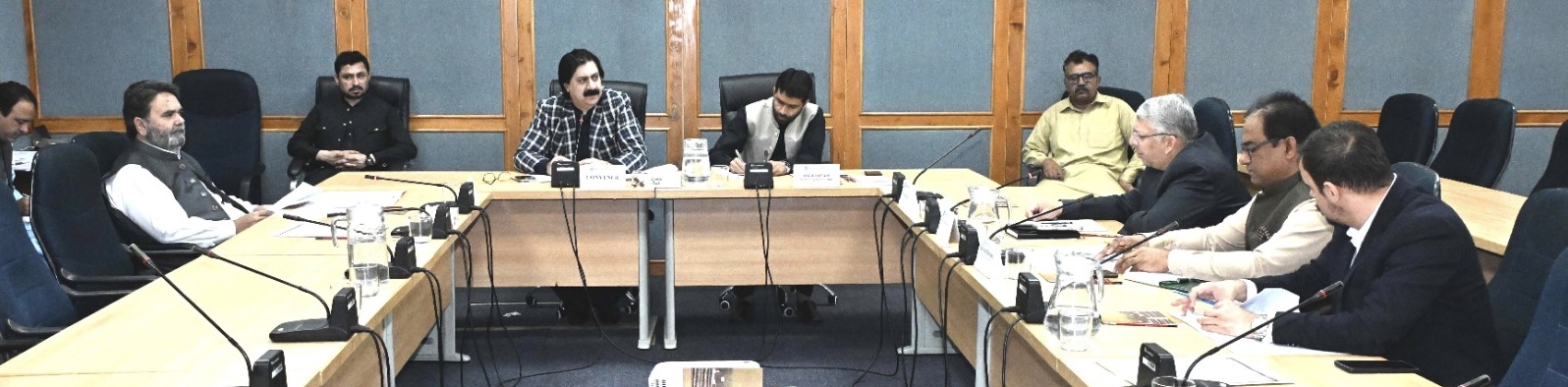
Islamabad , 16 April 2026(Kamran Raja):A meeting of the Sub-Committee of the Senate Standing Committee on Petroleum was held at Parliament Lodges under the convenership of Senator Manzoor Ahmad Kakar. The meeting was attended by Committee Member Senator Rana Mahmood ul Hassan, senior officials from the Ministry of Energy, and other relevant stakeholders.
The Sub-Committee conducted a comprehensive review of the legal and regulatory framework governing board appointments in public and semi-public entities. These included major organizations such as Pakistan Petroleum Limited, Oil and Gas Development Company Limited, Pakistan State Oil Company Limited, Sui Southern Gas Company Limited, Sui Northern Gas Pipelines Limited, and Pak-Arab Refinery Limited, among others.
During the briefing, officials informed the Committee that seven candidates had been shortlisted for the Board of Pakistan Petroleum Limited. Senator Manzoor Ahmad Kakar raised concerns over the inclusion of individuals previously placed on the Exit Control List (ECL), as well as those serving on multiple boards or facing audit objections. He emphasized that all appointments must be strictly merit-based to ensure transparency and competence.
The Committee was informed that one candidate had been removed from the shortlist following an internal inquiry. It was further clarified that under the current legal framework, particularly after the enactment of the Companies Act, the authority to appoint Managing Directors and Chief Executive Officers lies with the respective Boards of Directors rather than the federal government.
The Sub-Committee unanimously recommended amendments to the State-Owned Enterprises (SOEs) Act, 2023 to restore the authority of appointing MDs and CEOs to the Federal Government, in line with Articles 90, 91, and 99 of the Constitution, while retaining an advisory role for the Boards. The Committee also proposed a transparent performance evaluation system with active involvement of the concerned Ministry to ensure accountability and alignment with national policy.
On the petroleum supply situation, officials stated that around 90 percent of Pakistan’s petroleum imports come from Gulf countries through the Strait of Hormuz, with shipments typically arriving within eight days. The Committee was informed that Pakistan currently maintains petroleum reserves sufficient for about one month, while oil consumption has increased compared to last year.
The Committee also reviewed developments in the gas sector, noting that imported gas from Qatar remains available, although recent disruptions may delay full restoration. It was further shared that exploration activities are ongoing, with significant gas reserves recently discovered in the Tal Block.
Regarding LPG, the Committee was informed that approximately 50 percent is imported from Iran, 15 percent from other countries, and the remainder is met through domestic production.
Concluding the meeting, Senator Manzoor Ahmad Kakar stressed the importance of transparency, merit, and effective oversight to ensure responsible and efficient utilization of national resources.