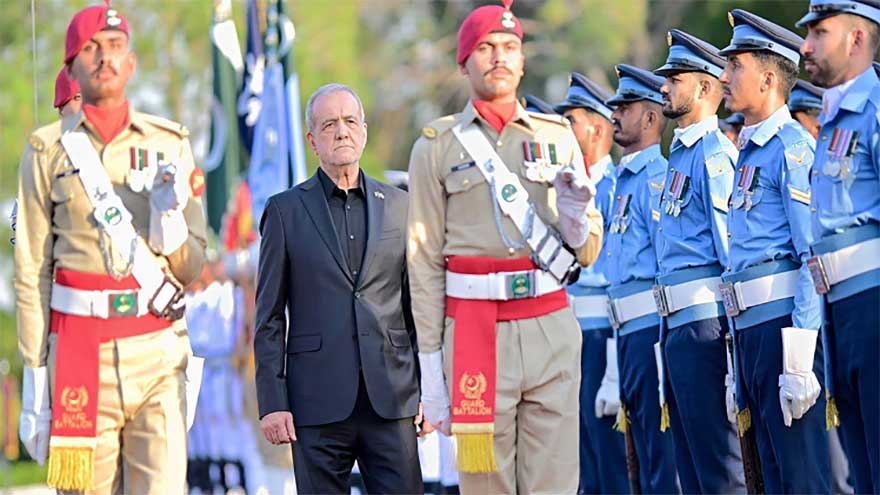
NEW YORK, 23 August, 2026 (News Desk): Iranian President Masoud Pezeshkian has defended a memorandum of understanding with the United States as the best way for Iran to move beyond what he described as a situation of “neither war nor peace,” as tensions continued across the Middle East. “There is not a single provision in this agreement that amounts to capitulation,” Pezeshkian said in a speech published by Iran’s state-run IRNA early Sunday. He added that the supreme leader sets the country’s policies and that the government would follow that path.The memorandum of understanding signed by US President Donald Trump in June set a 60-day deadline for ending the war with Iran and reaching an agreement on its nuclear programme. That period ended last week, but there have been no clear signs of compromise, particularly over the reopening of the Strait of Hormuz, a vital route for global shipping. Pezeshkian also linked the agreement to Iran’s economic prospects, saying the country could not attract investment while the current situation remained unresolved. Nearly six months into the war involving the United States and Israel, Iran’s economy has continued to suffer under sanctions and a naval blockade. Meanwhile, Mohsen Rezaei, the hard-line new head of Iran’s Supreme National Security Council, warned neighbouring countries against supporting new US efforts to pressure Iran’s economy. “If Trump wants to do something, we will retaliate in a seismic manner,” Rezaei said in an interview with Iran’s state broadcaster that aired Saturday. Rezaei, who was appointed this month as part of a series of senior appointments widely viewed as strengthening Tehran’s political and military stance, said Iran could target oil-shipping routes out of the Persian Gulf, including alternatives to the Strait of Hormuz, if neighbouring countries joined what he described as an economic war against Iran. Meanwhile, Pakistani Field Marshal Asim Munir will lead an official delegation to Tehran on Monday, Iranian state television reported, citing Iran’s Foreign Ministry spokesman Esmail Baghaei. Two regional officials said the visit was part of Islamabad’s continuing efforts to reduce tensions between the United States and Iran and encourage both sides to return to negotiations. The officials spoke on condition of anonymity because they were not authorised to discuss the matter publicly.
Iran’s judiciary also reported the latest execution linked to protests, identifying the man as Majid Adineh. The Mizan news agency said he was arrested on January 9 in Mohammadshahr, near Karaj, west of Tehran. Authorities said he was carrying a handgun with 30 rounds of ammunition, two stun guns, two cans of tear gas and a battery-powered chainsaw. The judiciary said forensic examinations indicated that the handgun had been fired on January 8 and 9. Mizan reported that Adineh had joined the unrest following calls by groups opposed to Iran’s government and alleged that he had received training from groups outside the country. A Revolutionary Court in Karaj later convicted Adineh under Iranian laws imposing harsher penalties for espionage and cooperation with hostile states. Mizan said the verdict accused him of carrying out operations on behalf of Israel, the United States and other groups considered hostile by Iran. Elsewhere in the occupied West Bank, Israeli police arrested a 16-year-old boy from the Israeli settlement of Avigayil in connection with the beating of a 61-year-old Palestinian man.Saeed Muhammad Ibrahim Rabah was struck with a pipe outside his home in Khirbet al-Rakeez in the southern West Bank, leaving him with bruises and pain. Rabah had lost a leg after being shot by a settler a year earlier. Rabah told The Associated Press that two settlers arrived at his home with a tractor on Saturday afternoon. One of them began moving stones that the family had placed at the entrance to the property and attempted to enter.Rabah said one settler struck him on the back with a pipe when he approached them to ask what they were doing. He said the violence was intended to force families like his to leave the area. “We will remain, no matter what happens,” Rabah said after going to the police on Sunday to file a report. “This is our land and this is our homeland, and we must protect it.” Police also questioned a 17-year-old from Jerusalem who allegedly stood nearby and filmed the assault with a mobile phone. Rabah said that in April 2025, he confronted settlers on his land while his son filmed the incident, and one of the settlers shot him in the leg, which was later amputated at a hospital. Separately, Israel’s military said Sunday that it was pursuing a suspect in a stabbing attack that injured a 24-year-old Israeli man in the area of al-Auja in the eastern West Bank. Israeli emergency services said the victim was taken to a hospital in moderate condition.
In Gaza, four-year-old Mohammed Taha died after an Israeli airstrike hit a house in central Gaza on Sunday, hospital authorities said. The strike in the town of Zawaida also wounded at least five other people, including a child, according to Al-Aqsa Martyrs Hospital, which received the casualties. The strike came minutes after residents said they received a warning from the Israeli military to evacuate the area where the house was located. The Israeli military did not immediately respond to a request for comment. In a statement released Sunday, Israeli Defense Minister Israel Katz said he had instructed the military to “act immediately and forcefully” to prevent the launching of balloons, kites or drones from Gaza toward Israeli communities along the border. “We view every launch as an act of war in every respect,” Katz said. Before the October 7, 2023 attack by Hamas-led militants on Israel, when 1,200 people were killed and 251 were taken hostage, burning kites and balloons were sent from Gaza into southern Israel, causing fires and other damage.Although the heaviest fighting has subsided since a fragile ceasefire in the Israel-Hamas war took hold in October, Israeli forces have carried out repeated airstrikes, killing more than 1,280 Palestinians, according to health officials in Gaza. The overall death toll in Gaza has surpassed 73,400 Palestinians, according to Gaza’s Health Ministry. The ministry, which is part of the Hamas-led government, maintains detailed casualty records that are considered generally reliable by UN agencies and independent experts, although it does not provide a breakdown between civilians and militants. Militants have also carried out shooting attacks against Israeli troops, while Israel says its strikes are in response to those attacks and other violations. Five Israeli soldiers have been killed since the ceasefire.