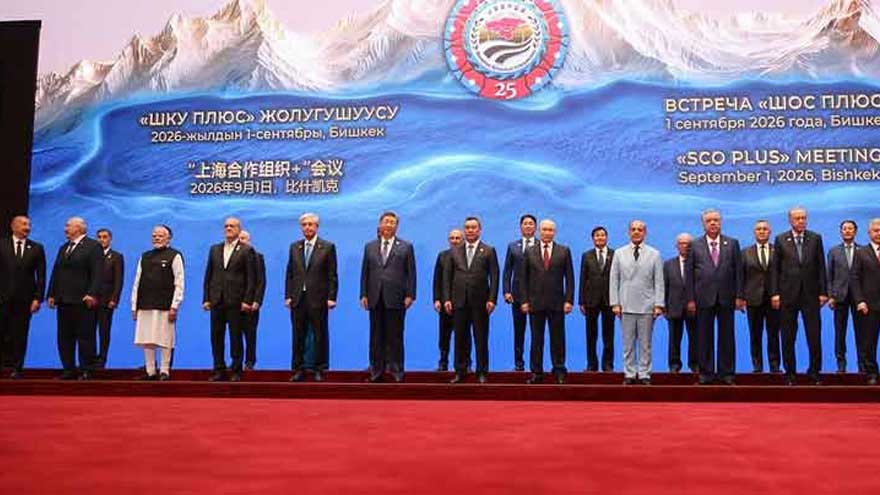
BISHKEK, 1 September, 2026 (Nosheen): Leaders of the Shanghai Cooperation Organisation (SCO) member states have signed the Bishkek Declaration, reaffirming their commitment to diplomacy, economic cooperation, counterterrorism, nuclear non-proliferation and regional stability. The declaration, adopted during the SCO summit, outlines the member states’ joint positions on major geopolitical and regional issues, including economic cooperation, terrorism, the Middle East, nuclear non-proliferation, Afghanistan and global security. Notably, the declaration made no reference to the Ukraine conflict. On human rights, SCO members rejected double standards and interference in the internal affairs of sovereign states while emphasizing the importance of respecting fundamental rights and freedoms. On economic issues, the member states supported an open, transparent, fair, inclusive and non-discriminatory multilateral trading system. They also opposed unilateral pressure and sanctions that violate the UN Charter, international law or World Trade Organization principles and could negatively affect the global economy, food and energy security, and human security. The Bishkek Declaration called for reforms to the global financial system and greater representation of developing countries in international financial institutions. SCO members also supported enhanced financial cooperation through the SCO Interbank Consortium and efforts to connect Iran’s designated bank to the system. Regarding the Middle East, SCO members expressed deep concern over the prevailing situation and reaffirmed support for Iran’s sovereignty and territorial integrity. They called for political and diplomatic solutions to regional conflicts and welcomed efforts aimed at reducing tensions. On counterterrorism, the member states condemned terrorism in all its forms and rejected attempts to use terrorist, separatist or extremist groups for political or other interests. They also opposed double standards in combating terrorism and called for coordinated international action under the central role of the United Nations.
The declaration reaffirmed the SCO members’ commitment to the Treaty on the Non-Proliferation of Nuclear Weapons and support for global nuclear disarmament and the international non-proliferation regime. At the same time, members reiterated their right to research, produce and use nuclear energy for peaceful purposes. SCO leaders stressed that the organisation is neither a military nor a political bloc and is not directed against any country or group. They reaffirmed the principles of mutual respect, equality, non-interference and openness, while supporting the peaceful settlement of international disputes. On outer space, the member states called for keeping space free from all types of weapons and supported the development of a legally binding international agreement to prevent an arms race in outer space. The declaration also expressed concern over the unilateral and unlimited expansion of global missile defence systems, describing such developments as harmful to international security and stability. It emphasized that no country should seek its own security at the expense of the security of others.SCO members reaffirmed their commitment to preserving the outcomes and historical memory of the Second World War and opposed attempts to distort or falsify history. On Afghanistan, the declaration stated that sustainable peace requires an inclusive government with broad representation of all ethnic and political groups. Members reiterated their support for Afghanistan as an independent, neutral and peaceful state free from terrorism, war and narcotics. The SCO countries also expressed their readiness to continue supporting international efforts aimed at promoting peace, stability and development in Afghanistan.