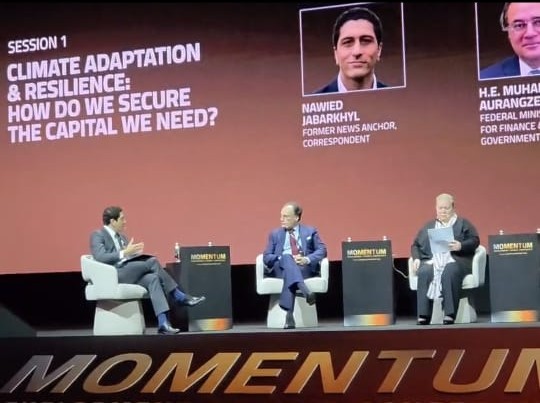
Riyadh, December 11, 2025(Nosheen): Federal Minister for Finance and Revenue Senator Muhammad Aurangzeb, Federal has underscored Pakistan’s urgent climate vulnerabilities and the country’s forward-looking financing strategy during a high-level panel discussion on “Climate Adaptation & Resilience: How do we secure the capital we need?” at the Global Development Finance Conference – Momentum 2025, being held in Riyadh. The session, attended by senior global finance leaders including H.E. Zeina Toukan, Minister of Planning and International Cooperation of Jordan; H.E. Qahhorzoda Faiziddin, Minister of Finance of the Republic of Tajikistan; and Mr. Serge Ekue, President of the West African Development Bank, explored the rising challenges of climate adaptation for emerging economies. Speaking on Pakistan’s recent experience with extreme climate events, the Finance Minister highlighted that climate change is an increasingly tangible and costly reality for Pakistan.
Recalling the devastating floods of 2022 that caused an estimated US$30 billion in losses and the renewed flooding witnessed this year, he noted that the frequency and intensity of such disasters are accelerating. As a result, Pakistan expects to lose roughly half a percentage point of GDP growth this year, placing additional strain on an already challenged emerging economy, he added. Senator Aurangzeb stated that Pakistan’s commitment to macroeconomic stability has enabled the creation of adequate fiscal and external buffers to manage immediate rescue and relief efforts through domestic resources. However, he emphasized that rehabilitation and reconstruction require substantial external support. He noted the positive progress made through the establishment of an AI-enabled early warning system at Pakistan’s National Emergency Center, which provides month-by-month climate forecasts that will allow more proactive planning and rapid response. Even so, he stressed that Pakistan’s own resources remain insufficient to meet the scale of adaptation needs, making multilateral partnerships and private sector engagement essential. Addressing questions on the balance between development imperatives and climate adaptation, Senator Aurangzeb said that as one of the world’s most climate-vulnerable countries, Pakistan must continue its efforts to mitigate emissions, but the more pressing challenge lies in adaptation financing.
He highlighted the Government of Pakistan’s 10-year Country Partnership Framework with the World Bank Group, which allocates roughly US$20 billion one-third of which is dedicated to climate resilience and decarbonization. The Minister underscored that the responsibility now lies with Pakistan to develop high-quality, bankable investment projects with urgency to unlock these funds. He expressed concern that global climate financing mechanisms, such as the Green Climate Fund and the Loss and Damage Fund, remain slow and bureaucratic, with lengthy accreditation processes that hinder timely access for vulnerable countries. In contrast, Pakistan has begun to effectively mobilize support through multilateral channels, including the recent receipt of the first tranche of US$200 million under the IMF Climate Resilience Fund. He reiterated that while fiscal resources will continue to be allocated domestically, external financing from development partners and international capital markets remains indispensable for Pakistan’s adaptation agenda. He called for a pragmatic, step-by-step approach focused on deploying the resources already available while working to close the wider financing gap.
Responding to a question on foreign investment and ensuring climate-aligned growth, the Finance Minister said that finance ministers worldwide must take the lead in mainstreaming climate priorities within national budgets to ensure alignment across government and financing mechanisms. He noted that Pakistan’s relationship with the United States has strengthened significantly, particularly in sectors such as minerals and mining, and advanced technologies including AI, blockchain and digital infrastructure. Discussing Pakistan’s flagship copper mining project, Reko Diq, he described it as a transformative development for the country’s economic and energy transition future. The project’s financial close valued at US$7 billion, with IFC leading the syndication and the U.S. EXIM Bank joining as a key participant marks a major milestone. Senator Aurangzeb highlighted that the mine is projected to generate export revenues equivalent to 10 percent of Pakistan’s current export base by its first year of commercial operation in 2028, establishing it as a major driver of growth and foreign exchange earnings. He added that Pakistan anticipates strong interest from U.S., Chinese, GCC and other international investors as the project scales, contributing both to national development and to global supply chains for energy transition materials.
When asked about navigating geopolitical dynamics between major powers, the Finance Minister said that Pakistan maintains an “and-and” approach to global partnerships. China remains a longstanding ally, particularly through the China-Pakistan Economic Corridor (CPEC), whose first phase focused on critical infrastructure. Pakistan has now launched CPEC Phase 2.0, which aims to commercialize this infrastructure through business-to-business partnerships, building on earlier government-to-government cooperation. He affirmed that Pakistan is well-positioned to maintain constructive relationships with both the United States and China, ensuring stability and opportunities for diversified foreign investment. The session concluded with reflections on the importance of regional and international cooperation in addressing climate challenges and promoting sustainable development. The panelists emphasized that despite the difficulties facing emerging economies, a shared commitment to resilience, innovation and collaborative financing can help countries protect their people, strengthen their economies and contribute positively to global climate goals.