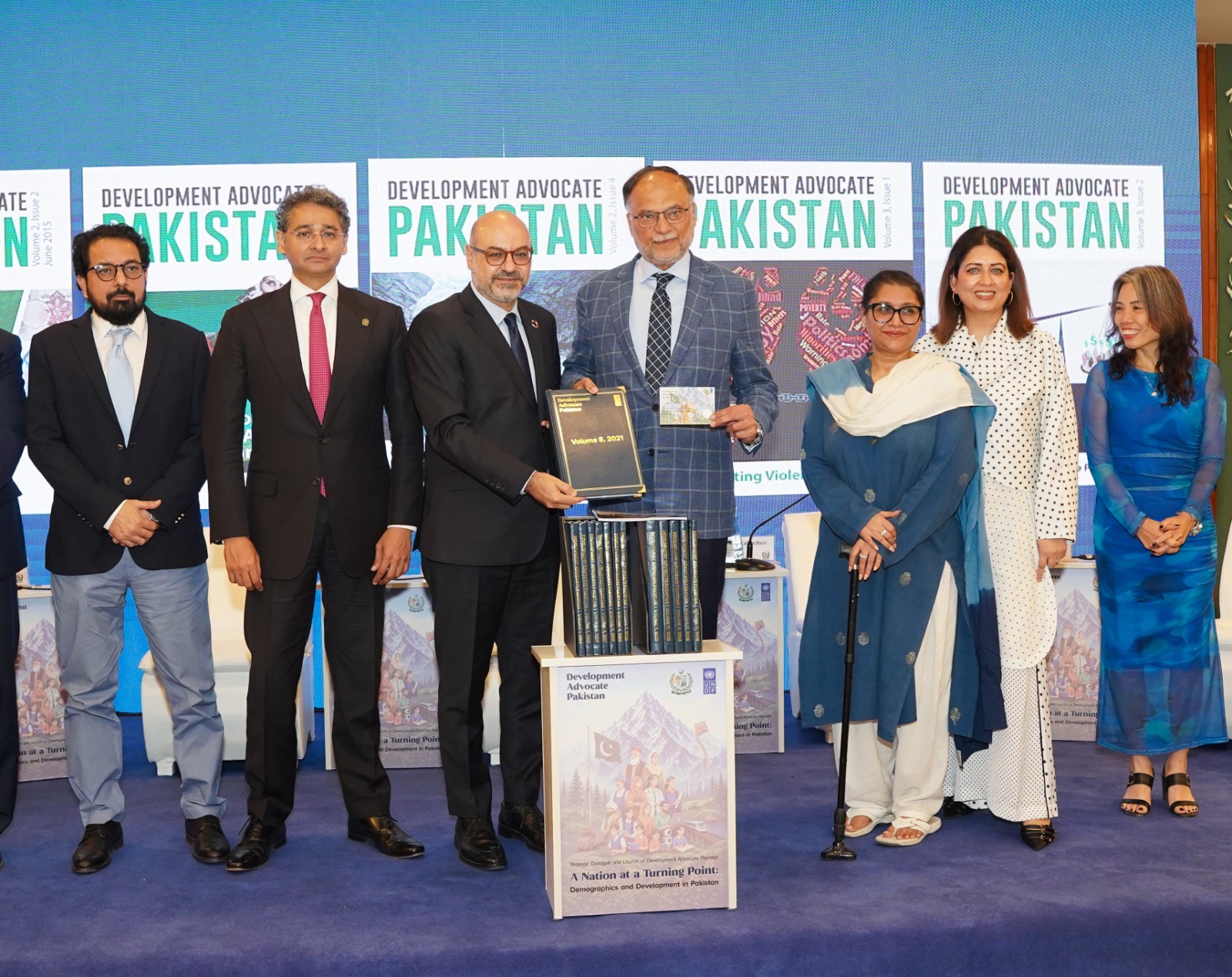
Islamabad, July 29, 2026(Nosheen): Federal Minister for Planning, Development and Special Initiatives, Professor Ahsan Iqbal, has emphasized that Pakistan stands at a critical juncture in its development journey where policy continuity, investment in human capital, evidence-based planning and positive societal transformation are essential to achieving sustainable, inclusive and long-term economic growth.
Addressing the Strategic Dialogue and Launch of the 50th Issue of Development Advocate Pakistan: “A Nation at a Turning Point,” the Minister said Pakistan’s young population represents its greatest strategic asset. He stressed that equipping youth with quality education, modern skills, healthcare and dignified employment opportunities is vital to transforming the country’s demographic advantage into sustained national prosperity.
The event was attended by representatives of the Pakistan Bureau of Statistics, the United Nations Development Programme (UNDP), the United Nations Population Fund (UNFPA), the National Institute of Population Studies, members of Parliament, development partners, policy experts and senior government officials.
The Minister described the launch of the 50th issue of Development Advocate Pakistan, along with its ten-year compendium, as a significant national milestone. He noted that the newly released national and provincial population projections provide a robust evidence base for future development planning and informed policymaking.
Highlighting one of Pakistan’s longstanding governance challenges, Ahsan Iqbal observed that the country’s development progress has repeatedly been undermined by the lack of policy continuity. He stated that major national development initiatives require consistent implementation over 10 to 15 years to achieve meaningful outcomes, but frequent policy shifts with changes in governments have prevented long-term visions such as Vision 2020 and Vision 2025 from realizing their full potential.
The Minister stressed that effective policymaking must be guided by credible data rather than aspirations. Referring to the Seventh Digital Population and Housing Census, he said Pakistan’s population has exceeded 241.5 million and is now estimated to be approaching 260 million. If current demographic trends persist, the population is projected to reach between 372 and 390 million by 2050. He noted that nearly 67 percent of Pakistan’s population is under the age of 30, creating a unique demographic dividend that can only be realized through strategic investments in education, technical and vocational training, digital skills and employment generation.
Expressing concern over the large number of out-of-school children and the significant proportion of young people—particularly women—who remain outside education, employment and skills training, the Minister said Pakistan must urgently strengthen its human capital to secure long-term economic competitiveness.
Ahsan Iqbal stated that Pakistan’s greatest challenge lies in its weak socio-economic structure, adding that sustainable economic progress requires stronger social foundations. He said the Government’s URAAN Pakistan initiative has been designed to address these structural challenges, while the 5Es National Development Framework provides an integrated strategy focused on exports and economic growth, E-Pakistan, environmental sustainability and climate resilience, energy and infrastructure, and equity and empowerment.
The Minister said the Government is progressively shifting development priorities from conventional infrastructure projects towards investments in people. Various initiatives are underway to promote youth entrepreneurship, digital and technical skills, vocational education, enrolment of out-of-school children and women’s economic empowerment, with the objective of making human capital the principal driver of national development.
Announcing a major initiative under URAAN Pakistan, Ahsan Iqbal said one million young Pakistanis will be trained as “Ambassadors of Social Change” to lead awareness campaigns in their communities on education, health, population management, sanitation and environmental protection. He emphasized that investment in artificial intelligence, emerging technologies, research and modern infrastructure is indispensable for building Pakistan’s future economy.
Calling for responsible civic behavior, the Minister noted that approximately 4,500 tonnes of plastic waste and garbage had recently been removed from Lahore’s drainage system following heavy rains, underscoring that infrastructure alone cannot effectively address urban flooding without public participation and responsible environmental practices.
He further emphasized that balanced population growth, climate resilience, water security and food security have become national priorities requiring coordinated action by the federal and provincial governments, the private sector, academia and development partners. He also urged the media to devote greater attention to national issues such as education, health, population and human development alongside political developments.
Highlighting Pakistan’s public health challenges, Ahsan Iqbal said more than 10 million Pakistanis are living with Hepatitis C, placing the country among those with the highest disease burden globally. He announced that the Federal Government has decided to make Islamabad and adjoining areas Hepatitis-free, with similar initiatives being expanded to Gilgit-Baltistan and Azad Jammu and Kashmir. He called upon provincial governments to undertake comparable efforts across the country.
Referring to the growing prevalence of diabetes, the Minister stressed the need to promote healthier lifestyles. He also expressed concern that Pakistan and Afghanistan remain the only countries where polio has yet to be eradicated, describing attacks on polio workers as contrary to the national interest and emphasizing that public awareness and behavioral change are critical to eliminating preventable diseases.
Underscoring the importance of Early Childhood Development, Ahsan Iqbal noted that nearly 90 percent of brain development occurs during the first five years of a child’s life. He said proper nutrition, healthcare and early education during this critical period lay the foundation for a productive society. He further observed that many social problems, including crime and drug addiction, often stem from adverse childhood experiences. Expressing concern over Pakistan’s literacy rate of around 60 percent and the high prevalence of child stunting due to malnutrition, he called for urgent national action to address these challenges.
The Minister appreciated the contributions of the United Nations Development Programme (UNDP), the United Nations Population Fund (UNFPA), the Pakistan Bureau of Statistics, the National Institute of Population Studies and other development partners for providing research, technical expertise and evidence-based analysis to support national policymaking. He said the special edition of Development Advocate Pakistan would serve as an important reference for future planning and development.
He also highlighted the role of the National Population Council, established under the leadership of the Prime Minister, in advancing Pakistan’s human capital agenda through close coordination between the Federation and the provinces.
Concluding his address, Professor Ahsan Iqbal reaffirmed the Government’s commitment to investing in youth, women, education, healthcare, technology and long-term structural reforms, expressing confidence that Pakistan’s demographic potential can be transformed into sustainable prosperity, inclusive development and enduring economic stability through collective national effort.