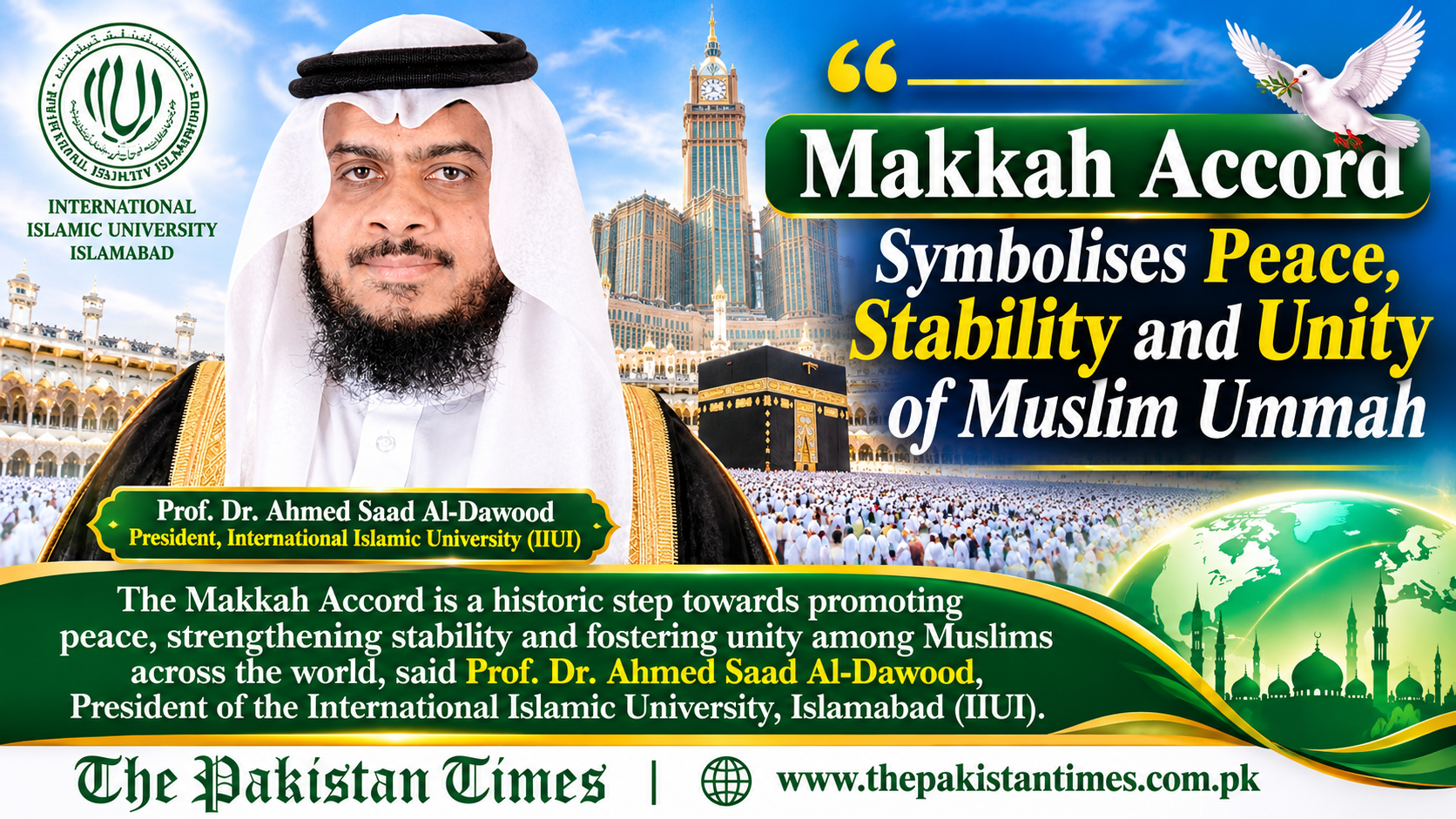
Islamabad, 27 November 2026(Kamran Raja): Prof. Ahmed Saad Alahmed, Acting Rector and President of the International Islamic University Islamabad (IIUI), has termed the Makkah Accord a significant initiative for promoting peace, stability and collective security among Muslim countries, while reaffirming the university’s commitment to strengthening educational cooperation with Saudi Arabia.
In a statement issued on Friday, Prof. Alahmed said the accord reflected the visionary leadership of the Custodian of the Two Holy Mosques, King Salman bin Abdulaziz Al Saud, and Crown Prince and Prime Minister of Saudi Arabia, Mohammed bin Salman bin Abdulaziz Al Saud.
He said the agreement carried profound significance for the Muslim world and represented a shared commitment to solidarity, mutual support and regional stability.
Saudi Arabia, Türkiye and Pakistan signed the Makkah Joint Defence Agreement on August 7, 2026, at Al-Safa Palace in Makkah Al-Mukarramah. The agreement stipulates that an armed attack against one member would be considered an attack against all, reflecting the spirit of collective defence and unity.
Prof. Alahmed congratulated the leadership and people of the three brotherly countries on the landmark initiative and welcomed Islamabad’s hosting of the third meeting of the Strategic Political and Defence Committee of the Makkah Accord on November 26 and 27.
He described the meeting as an important milestone in translating shared commitments into practical cooperation, expressing confidence that it would further strengthen coordination among the participating countries.
The committee comprises the foreign and defence ministers and military chiefs of the three countries. During its inaugural meeting in Istanbul in August, the members agreed to establish a permanent secretariat in Riyadh, while the second meeting was held in Saudi Arabia.
The IIUI President said the university remained a longstanding symbol of the enduring friendship between Pakistan and Saudi Arabia. He acknowledged the Kingdom’s continued support and academic cooperation, which have significantly contributed to the university’s educational and research mission.
He reaffirmed IIUI’s readiness to expand cooperation with Saudi educational institutions through student and faculty exchanges, scholarships, joint research, academic conferences, Arabic language programmes and collaboration in emerging technologies.
Such initiatives, he said, would empower young people with modern knowledge, professional skills and strong ethical values, while supporting Saudi Vision 2030 and Pakistan’s national development objectives.
Prof. Alahmed noted that IIUI was established to integrate Islamic scholarship with contemporary knowledge and serve the intellectual and educational needs of the Muslim Ummah.
He said the university’s diverse academic community demonstrated how Muslim countries could strengthen their societies through mutual learning, research and intellectual exchange.
Highlighting the role of educational institutions in promoting peace, he said IIUI’s faculties of Shariah and Law, Usuluddin, Arabic and Social Sciences, along with the Islamic Research Institute and other academic centres, could contribute meaningful research and dialogue on international law, peacebuilding, economic cooperation, media and challenges confronting Muslim societies.
He added that IIUI could provide a valuable platform for scholars and intellectuals from Pakistan, Saudi Arabia and Türkiye to exchange ideas and develop a shared understanding of contemporary regional and global issues.
Encouraging students to play an active role in strengthening bilateral and trilateral relations, Prof. Alahmed said young people could serve as ambassadors of brotherhood through academic excellence, moderation and mutual respect.
He emphasised that sustainable security required more than military strength, noting that education, understanding and shared values were equally essential for lasting peace.
The IIUI President expressed the university’s readiness to contribute to the objectives of the Makkah Accord through education, research and intellectual cooperation.
He prayed for the success of the agreement and lasting peace, stability and prosperity in Saudi Arabia, Pakistan, Türkiye and the entire Muslim Ummah.