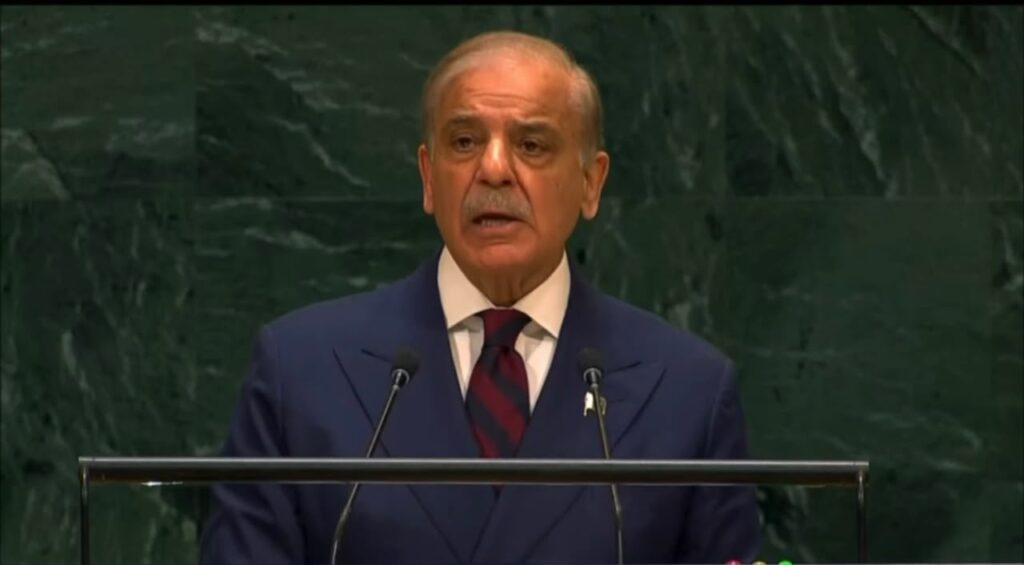
NEW YORK, 25 September, 2026 (Kamran Raja): Prime Minister Muhammad Shehbaz Sharif, addressing the 81st session of the United Nations General Assembly, reaffirmed Pakistan’s commitment to peace, dialogue, multilateralism and the principles of the UN Charter, while highlighting major regional and global challenges. Addressing the UN General Assembly, the Prime Minister said Pakistan had chosen dialogue over confrontation, cooperation over coercion and peace over war. He urged the international community to work collectively to restore trust and prevent conflicts. He congratulated the President of the 81st General Assembly session, Khalil ur Rahman, and appreciated the leadership of UN Secretary-General Antonio Guterres and former General Assembly President Annalena Baerbock. Expressing concern over the escalation of conflict in the Gulf and wider Middle East, he stressed that diplomacy must prevail over confrontation. He said the Strait of Hormuz and Bab-al-Mandeb were vital arteries of the global economy and should remain open for international commerce, while condemning attacks against Saudi Arabia and expressing Pakistan’s solidarity with the Saudi people. He said the Makkah Joint Defence Agreement among Saudi Arabia, Türkiye and Pakistan was aimed at strengthening defence, stability and peace in the region and was not directed against any country. On South Asia, Prime Minister Shehbaz Sharif reiterated Pakistan’s position on the Jammu and Kashmir dispute and called for a just and fair settlement, reaffirming Pakistan’s diplomatic, political and moral support for the Kashmiri people and their right to self-determination. He also raised concerns over the Indus River system, maintaining that the Indus Waters Treaty remained valid and that water must never be weaponized. Highlighting the humanitarian situation in Palestine, the Prime Minister called for an end to violence against civilians and reiterated Pakistan’s support for an independent, sovereign, viable and contiguous State of Palestine based on the pre-1967 borders, with Al-Quds Al-Sharif as its capital. He also called for an end to aggression against Lebanon and Syria. On terrorism, he said it remained one of the gravest threats to international peace and security and highlighted Pakistan’s sacrifices in combating the menace. He called on the Afghan authorities to fulfil their international commitments and take verifiable and decisive action to prevent Afghan territory from being used against Pakistan or any other country, while stressing the importance of protecting the fundamental rights of the Afghan people, particularly women and girls.
The Prime Minister said economic revival remained a major priority of his government, highlighting structural reforms, fiscal discipline, modernization of agriculture and industry, mineral development, digitalization and efforts to equip young people with artificial intelligence and information technology skills. He emphasized expanded economic cooperation with China through the China-Pakistan Economic Corridor, as well as with the Gulf, Central Asia and other regions. Calling for debt relief, affordable long-term financing and greater representation for developing countries in international financial institutions, he stressed that development should receive the same urgency as security. Highlighting Pakistan’s vulnerability to climate change, Prime Minister Shehbaz Sharif urged developed countries to honour their climate-finance commitments and provide support for loss and damage, adaptation and resilience. He also called for reforms to make the United Nations stronger, more coherent and effective, including a more representative, democratic and accountable Security Council. Summing up Pakistan’s position, he said: “Reform for All — Privilege for None.” Concluding his address, the Prime Minister said the world was passing through a dangerous period but emphasized that the future was not predetermined. “War is a choice. Peace is also a choice,” he said, calling on the international community to restore trust, preserve peace and demonstrate that humanity could still stand together despite divisions.