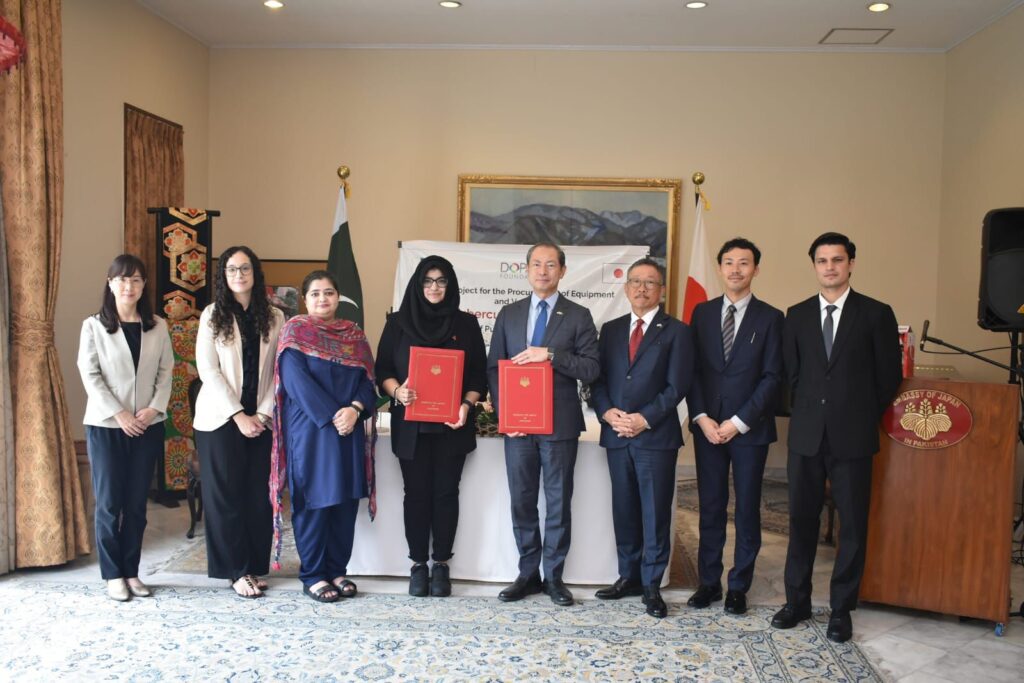
ISLAMABAD, 1 September 2026 (Ghufran): The Government of Japan has approved grant assistance of 21 million Japanese Yen, approximately USD 142,500, to the Dopasi Foundation under its Grant Assistance for Grassroots Human Security Projects (GGP) Programme. The grant will support the procurement of specialized equipment and a vehicle for tuberculosis (TB) screening in Islamabad, Rawalpindi and Chakwal, with the aim of improving access to early diagnosis and essential healthcare services for vulnerable and marginalized communities. The grant contract was signed at the Embassy of Japan in Islamabad between Ambassador of Japan to Pakistan H.E. Mr. AKAMATSU Shuichi and a representative of the Dopasi Foundation on September 1, 2026. The project, titled “The Project for the Procurement of Equipment and Vehicle for Tuberculosis Screening in Two Districts of Punjab Province and Islamabad City,” will enable the Dopasi Foundation to deploy a fully equipped Mobile Health Unit in the targeted areas. The mobile unit will provide digital chest radiography, tuberculosis screening, family planning counselling and basic health checks to underserved communities, including daily wage earners, women and families facing barriers to accessing healthcare facilities.The Dopasi Foundation, a humanitarian organization with more than 200 staff members, has been working to support underprivileged communities in Pakistan and has expanded its healthcare initiatives over the years. The project has also received technical support from Toyota Tsusho Corporation in collaboration with Fujifilm. The companies will support the development of a specially equipped Land Cruiser featuring a compact X-ray system and artificial intelligence technology for TB screening, along with a local maintenance system to ensure sustainable operation.
Toyota Tsusho and Fujifilm will also provide technical training to facilitate the effective and sustainable use of the equipment. The project is expected to provide high-quality medical screening to approximately 20,000 people annually, helping reduce the impact of communicable diseases and healthcare access barriers on vulnerable households. Early diagnosis through the project is also expected to contribute to saving lives, reducing catastrophic healthcare expenditures and strengthening the long-term socio-economic resilience of vulnerable families. Speaking at the signing ceremony, Ambassador AKAMATSU Shuichi said that human security begins with protecting every individual life, which remains a fundamental principle of Japan’s development cooperation. He emphasized that access to early diagnosis and basic health services is directly linked to saving lives and helping families overcome vulnerability. The Government of Japan reiterated its commitment to supporting capable local non-governmental organizations in Pakistan through grant assistance aimed at advancing human security and improving the well-being of vulnerable communities. Japan expressed hope that the project would further contribute to strengthening the long-standing friendship and cooperation between Japan and Pakistan.