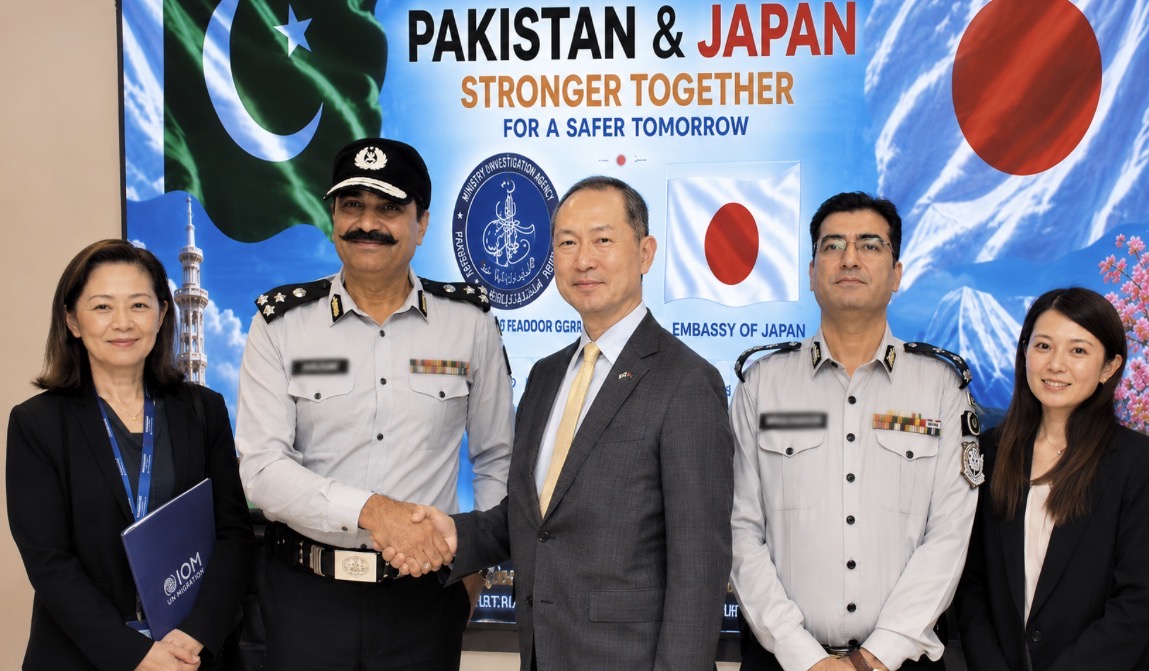
 Islamabad , 30 July 2026(Kamran Raja):Pakistan’s border management and migration governance have received a significant boost following the successful completion of a four-year capacity-building initiative funded by the Government of Japan and implemented by the International Organization for Migration (IOM). The project concluded with the formal handover of advanced border management equipment, transport vehicles, and institutional resources to the Federal Investigation Agency (FIA) during a ceremony held at FIA Headquarters in Islamabad.
The event was attended by Japanese Ambassador to Pakistan H.E. Akamatsu Shuichi, IOM Pakistan Chief of Mission Mio Sato, FIA Director General Dr. Usman Anwar, along with senior officials from the Embassy of Japan, IOM, and the FIA.
The initiative represents one of the most comprehensive international collaborations aimed at strengthening Pakistan’s ability to manage its borders while ensuring safe, orderly, and rights-based migration. Throughout the project, modern technology, specialized training, institutional reforms, and operational support were provided to enhance Pakistan’s response to transnational crimes, including human trafficking, migrant smuggling, and cross-border criminal networks.
As part of the final phase of the project, IOM handed over advanced border management equipment and transport vehicles to the FIA. Three dedicated transport vans were provided for deployment at Pakistan’s busiest international airports in Islamabad, Karachi, and Lahore.
The vehicles will facilitate the safe reception, protection, and onward transportation of returning migrants, improving both operational efficiency and humanitarian support at key entry points.
The project also supplied a wide range of biometric, communication, surveillance, information technology, and security equipment to 21 FIA operational locations across Pakistan. In addition, specialized equipment was provided to the FIA’s National Command and Control Centre (NC3), enabling improved intelligence gathering, operational coordination, and monitoring of transnational criminal activities.
Beyond infrastructure and equipment, the initiative placed considerable emphasis on strengthening FIA’s institutional capacity through training and professional development.
A major component of the project included the refurbishment and modernization of the FIA Training Academy, completed earlier this year. The upgraded academy now offers improved classrooms, enhanced security systems, modern learning facilities, and an advanced training environment designed for both newly recruited and serving FIA officers.
With the academy training approximately 1,000 officers annually, the investment is expected to produce long-term improvements in Pakistan’s border management capabilities and law enforcement standards.
More than 150 FIA officers received specialized instruction in areas including human rights, gender-responsive policing, investigative techniques, biometric verification, documentation procedures, and integrated border management.
The project also helped establish a sustainable network of FIA master trainers, including female officers, ensuring that knowledge and expertise developed under the initiative will continue to benefit future generations of investigators and border officials.
The programme extended beyond the FIA by involving provincial police officials and representatives from civil society organizations. More than 200 participants received specialized instruction on protection-sensitive approaches to combating human trafficking and migrant smuggling.
Training modules covered victim identification, screening procedures, referral mechanisms, and protection frameworks, with particular emphasis on supporting vulnerable groups. Women accounted for more than half of the participants, highlighting the project’s commitment to inclusive capacity building.
Speaking at the ceremony, FIA Director General Dr. Usman Anwar expressed gratitude to the Government of Japan and the International Organization for Migration for their sustained support in enhancing Pakistan’s border management systems.
He highlighted the importance of the National Command and Control Centre, noting that the newly provided resources would significantly strengthen operational monitoring, intelligence coordination, and the agency’s ability to respond effectively to transnational crime.
Dr. Anwar said the initiative would leave a lasting institutional legacy by improving professional skills, operational readiness, and inter-agency coordination across Pakistan’s border management system.
Japanese Ambassador H.E. Akamatsu Shuichi emphasized that effective border security and the protection of human rights should go hand in hand.
He stated that strong and professional border management institutions not only safeguard national security but also uphold the dignity and rights of individuals. According to the ambassador, Japan remains committed to supporting Pakistan through partnerships that promote secure, humane, and efficient border governance.
He added that the collaboration demonstrates the value of sustained international cooperation in addressing increasingly complex migration challenges and cross-border criminal activities.
IOM Pakistan Chief of Mission Mio Sato noted that modern border management extends well beyond controlling the movement of people. She emphasized that today’s border governance integrates national security, economic connectivity, regional cooperation, and the protection of human dignity.
She said Japan’s continued support has strengthened Pakistan’s institutional capacity while helping establish sustainable systems capable of addressing future migration and border management challenges.
Mio Sato also acknowledged the leadership of the FIA and the close cooperation among all stakeholders throughout the implementation of the project.
The completion of the Japan-funded initiative marks an important milestone in Pakistan’s efforts to modernize border management through advanced technology, trained personnel, improved institutional capacity, and coordinated intelligence systems.
Officials believe the project has laid the foundation for a more efficient, technology-driven, and human rights-based border management framework capable of addressing evolving security and migration challenges while maintaining international standards of dignity, protection, and lawful migration.
The successful partnership between the Government of Japan, the International Organization for Migration, and the Federal Investigation Agency is expected to serve as a model for future international cooperation in strengthening Pakistan’s security institutions and migration governance