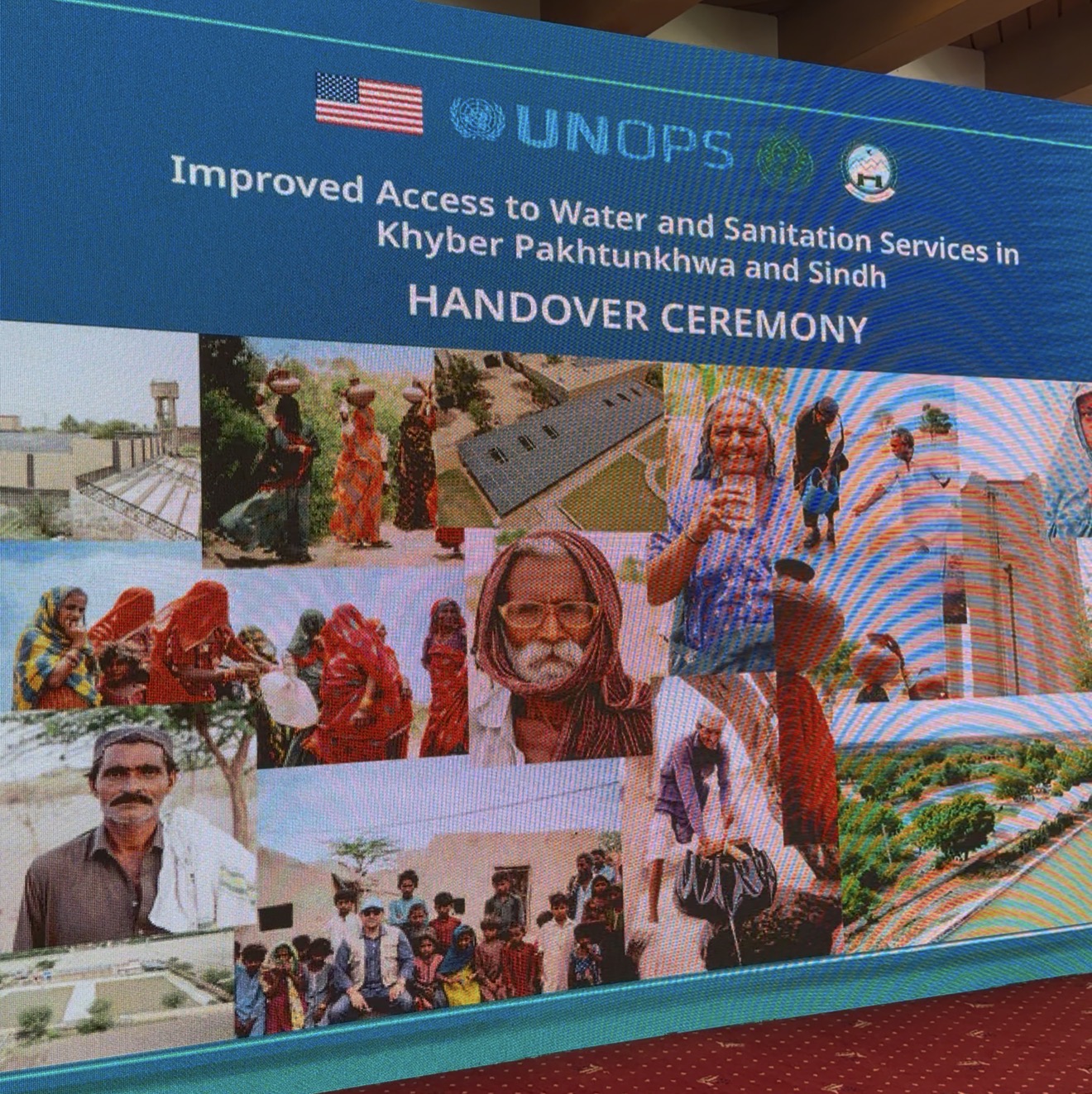
 Islamabad, 23 July 2026(Kamran Raja): The United Nations Office for Project Services (UNOPS), with financial support from the United States Department of State, has formally handed over major Water, Sanitation and Hygiene (WASH) infrastructure projects to the Public Health Engineering Departments (PHED) of Sindh and Khyber Pakhtunkhwa, marking the successful completion of a USD 7.6 million initiative aimed at improving access to safe drinking water and sanitation for nearly 300,000 people.
The project, titled “Improved Access to Water and Sanitation Services in KP and Sindh,” has transformed communities in Umerkot District, Sindh, and Tank District, Khyber Pakhtunkhwa by providing sustainable water supply systems, improved sanitation facilities, renewable energy solutions, and institutional capacity-building.
A formal handover ceremony was held in Islamabad, bringing together senior government officials, donor representatives, development partners, and beneficiaries from the project communities. Among those attending were Angelina Wilkinson, Assistance Coordinator at the U.S. Embassy in Islamabad; Sara Netzer, Regional Director for Asia and the Pacific at UNOPS; Usman Akram, Director of the South Asia Multi-Country Office, UNOPS; Jennifer Ankrom, Country Manager of UNOPS Pakistan; MPA Qasim Soomro; and senior officials from the Public Health Engineering Departments, Planning and Development Departments, and Local Government Departments of Sindh and Khyber Pakhtunkhwa.
Speaking at the ceremony, Angelina Wilkinson reaffirmed the United States’ commitment to improving public health and sustainable development in Pakistan.
“Clean water and sanitation are the foundation of healthy, thriving communities. Through this project, the American people have delivered reliable water and sanitation services to more than 295,000 Pakistanis while strengthening Pakistan’s institutional capacity to sustain these gains for future generations,” she said.
Highlighting UNOPS’ expertise in sustainable infrastructure development, Sara Netzer, Regional Director for Asia and the Pacific, UNOPS, said the organization remains committed to delivering resilient infrastructure that improves lives.
“This five-year initiative demonstrates how strong partnerships between UNOPS, the U.S. Department of State, and provincial governments can deliver lasting development outcomes. We are proud to have provided sustainable water and sanitation services that will benefit communities in Tank and Umerkot for decades to come,” she stated.
The project has delivered six drinking water supply schemes, including the rehabilitation of existing systems and construction of new infrastructure. More than 40 kilometres of water distribution pipelines have been installed, along with over 1,300 water collection points, significantly improving access to safe drinking water across both districts.
A fully equipped water testing laboratory has also been established and transferred to the Public Health Engineering Department, enabling continuous monitoring of water quality for approximately 164,000 residents.
Recognizing the importance of sanitation alongside clean water, the project also constructed six modern school toilet blocks, benefiting more than 6,400 students by providing safe and hygienic sanitation facilities and helping improve school attendance.
To promote environmentally sustainable development, UNOPS installed more than half a megawatt of solar power capacity across the water supply schemes. These solar-powered systems operate independently of the national electricity grid, ensuring uninterrupted water supply while reducing carbon emissions and supporting climate resilience.
Community members from Tank and Umerkot shared how improved access to safe drinking water has reduced the burden of collecting water, particularly for women and girls. With water now available closer to home, many women are able to dedicate more time to income-generating activities such as handicrafts, agriculture, and kitchen gardening, contributing to improved household livelihoods.
Elected representatives from the beneficiary districts expressed appreciation to the United States Government and UNOPS for delivering sustainable development solutions to underserved communities.
They noted that the project has transformed daily life by replacing long journeys to collect water with reliable doorstep access, improving public health, supporting education, and creating new economic opportunities.
Following the formal handover, the Public Health Engineering Departments of Sindh and Khyber Pakhtunkhwa will assume responsibility for the operation and maintenance of the infrastructure. UNOPS will continue supporting provincial authorities through targeted capacity-building programmes covering water supply operations, WASH management, water quality monitoring, health and safety, and project management to ensure the long-term sustainability of the systems.
The initiative is expected to provide lasting benefits by improving public health, expanding access to essential services, strengthening local institutions, and supporting resilient and sustainable community development across the two provinces.