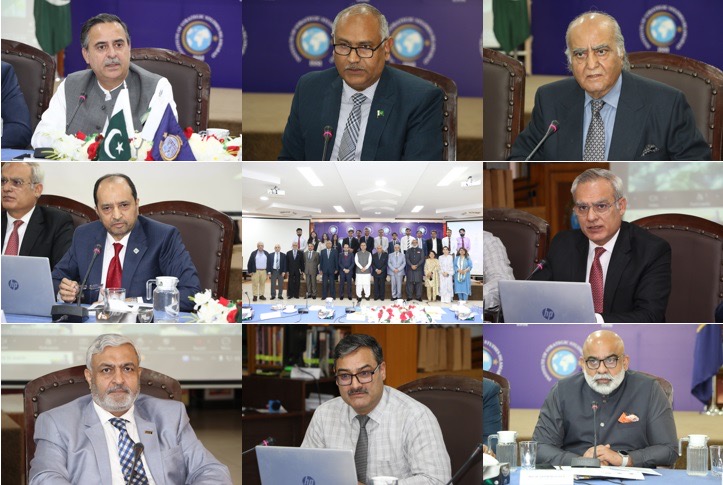
Islamabad, 29 April 2026(Ghufran): The Arms Control and Disarmament Centre (ACDC) at the Institute of Strategic Studies Islamabad (ISSI), in collaboration with the National Institute of Maritime Affairs (NIMA), organized a high-level seminar titled “The Impact of the Current Geopolitical Situation on Maritime Trade in the Indian Ocean Region.” The event brought together leading policymakers, maritime experts, and academics to deliberate on evolving regional dynamics and their implications for global trade and security.
Federal Minister for Maritime Affairs, Muhammad Junaid Anwar Chaudhry, graced the occasion as Chief Guest. In his keynote address, he underscored that the current geopolitical crisis offers critical lessons for Pakistan across multiple sectors. He highlighted that several long-pending reforms, infrastructure projects, and legislative measures in the maritime domain have been expedited in response to emerging challenges. Emphasizing the strategic role of Karachi Port, the Minister noted its success in handling increased foreign transshipment activity. He also announced a package of fiscal incentives, including up to 60 percent concessions in port-related charges, aimed at attracting foreign-flagged vessels and boosting shipping activity. He stressed the importance of strengthening Pakistan’s internal capacity to reduce reliance on external actors.
In his welcome remarks, Ambassador Khalid Mahmood, Chairman of ISSI’s Board of Governors, highlighted that the ongoing conflict involving the United States, Israel, and Iran has severely disrupted global maritime trade. He pointed out that the Strait of Hormuz—a critical artery for global energy supply—has remained largely inaccessible to commercial traffic, significantly impacting oil and LNG flows. He emphasized that the crisis has exposed vulnerabilities in global supply chains and maritime governance frameworks, calling for a shift from reactive to proactive maritime strategies. He also stressed the need to leverage Gwadar Port as a regional transshipment and energy transit hub.
Earlier, Director ACDC-ISSI, Malik Qasim Mustafa, in his introductory remarks, highlighted Pakistan’s growing diplomatic role in mediating tensions and facilitating dialogue to prevent further escalation.
The seminar featured prominent speakers including Rear Admiral Shahid Ahmed (Retd.), Chairman KPT; Rear Admiral Syed Faisal Shah (Retd.), Defence & Security Analyst; Prof. Dr. Adam Saud; Commodore Dr. Baber Bilal Haider (Retd.); and Rear Admiral Javaid Iqbal.
Speakers observed that the Indian Ocean Region is undergoing a major transformation driven by disruptions in key maritime chokepoints, including the Strait of Hormuz and the Red Sea, alongside intensifying great-power competition. They noted Pakistan’s effective response, including increased port capacity, improved efficiency, and reduced transshipment costs. The discussion also emphasized the long-term structural shifts in global trade routes and the growing importance of alternative corridors such as the China-Pakistan Economic Corridor (CPEC).
Experts further highlighted gaps in existing maritime governance mechanisms, noting the absence of binding enforcement and structured de-escalation protocols. The role of the Pakistan Navy in ensuring the security of Sea Lines of Communication (SLOCs) and protecting the country’s Exclusive Economic Zone (EEZ) was also acknowledged.
In his concluding remarks, Rear Admiral Javaid Iqbal expressed appreciation to ISSI and NIMA for organizing the seminar. He commended the Ministry of Maritime Affairs for its proactive role during the crisis, noting that Pakistan’s maritime sector recorded a historic profit of Rs. 100 billion in 2025. He also highlighted the timely implementation of key reforms under SRO 525 of 2026, which have contributed to positioning Pakistan’s ports as emerging regional transshipment hubs.