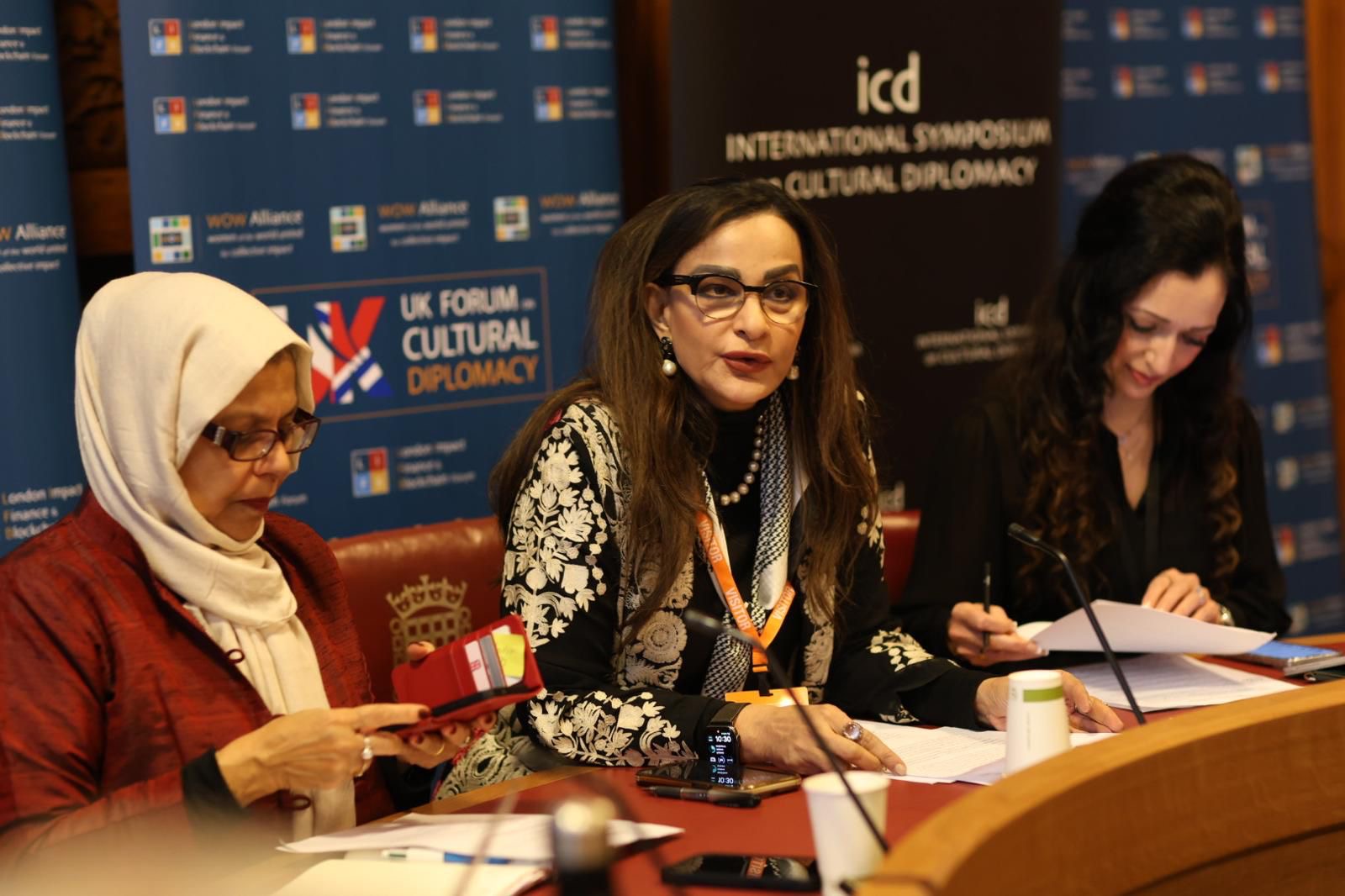
London, UK, 12 January 2026(Kamran Raja): At the UK Forum on Cultural Diplomacy held at the House of Lords, Senator Sherry Rehman—Vice President of the Pakistan Peoples Party (PPP) and Chairperson of the Senate Standing Committee on Climate Change—delivered a powerful keynote address on “Women in Politics,” urging global political systems to move beyond symbolic celebration toward meaningful structural reform.
Senator Rehman framed women’s political participation around three interconnected imperatives: assessing current realities, understanding what women need from politics, and shaping collective agendas capable of transforming societies.
Citing global statistics, she highlighted the stark underrepresentation of women in leadership, noting that women hold only 27.2 percent of parliamentary seats worldwide and that just 29 countries currently have women as Heads of State or Government. At prevailing trends, she warned, achieving gender parity in political leadership could take more than 130 years (UN, 2025), calling this gap “a stark indictment of the systems that shape public life.”
Despite these challenges, Senator Rehman emphasized that women’s leadership has a transformative impact. “When women lead,” she noted, “they ask different questions, set new priorities, and model collaborative, inclusive, and people-centric governance.” Referring to the COVID-19 pandemic, she observed that countries led by women responded faster, communicated more clearly, and on average suffered significantly fewer fatalities than male-led nations.
Reflecting on Pakistan’s political history, Senator Rehman paid tribute to Shaheed Mohtarma Benazir Bhutto, describing her as an iconic leader who paved the way for generations of women by becoming the first woman elected Prime Minister of a Muslim-majority country. She recalled Benazir Bhutto’s commitment at the 1995 Beijing Conference to a transformative global agenda for women’s rights, questioning why, three decades later, many of those gains remain under threat.
She cautioned that as global conflicts intensify and multilateralism weakens, rights protections are eroding worldwide. “Rights and the Sustainable Development Goals are no longer the global priority the world once envisioned for the 21st century,” she remarked.
Turning to Pakistan, Senator Rehman highlighted both the challenges and achievements of women parliamentarians. Although women constitute only 17 percent of Pakistan’s legislature, they contributed nearly 50 percent of all parliamentary business in the previous year. She described this as reflective of the “invisible care economy women sustain everywhere, and the additional labour they shoulder in public life.”
Outlining her own legislative journey since 2002, Senator Rehman noted her role in advancing five key laws to protect and empower women, including legislation on workplace harassment, child marriage restraint, domestic violence, and mandatory political participation for women within political parties. She underscored the importance of persistence and coalition-building, stating, “Women pass the baton across generations. Coalition-building is our political muscle.”
She also highlighted Pakistan’s gender-responsive social protection initiatives, particularly the Benazir Income Support Programme (BISP), which provides direct cash transfers to women, strengthening their economic agency and decision-making power within households and communities. She noted that over two million women now hold ownership rights in climate-resilient housing projects, reshaping local power dynamics in flood-affected regions.
Despite progress, Senator Rehman expressed concern over the rising abuse and harassment faced by women lawmakers globally. She cited data showing that 82 percent of women parliamentarians experience harassment, including digital violence and threats, with nearly 44 percent facing online threats of death or assault.
Concluding her address, Senator Rehman called for sustained global alliances and solidarity. “There is no silver bullet for dismantling structural exclusion and misogyny,” she said. “But when women’s voices are stifled, we must insist on being heard. Change comes at a cost, and we are prepared to pay it with political stamina and solidarity. That solidarity is our greatest strength.”