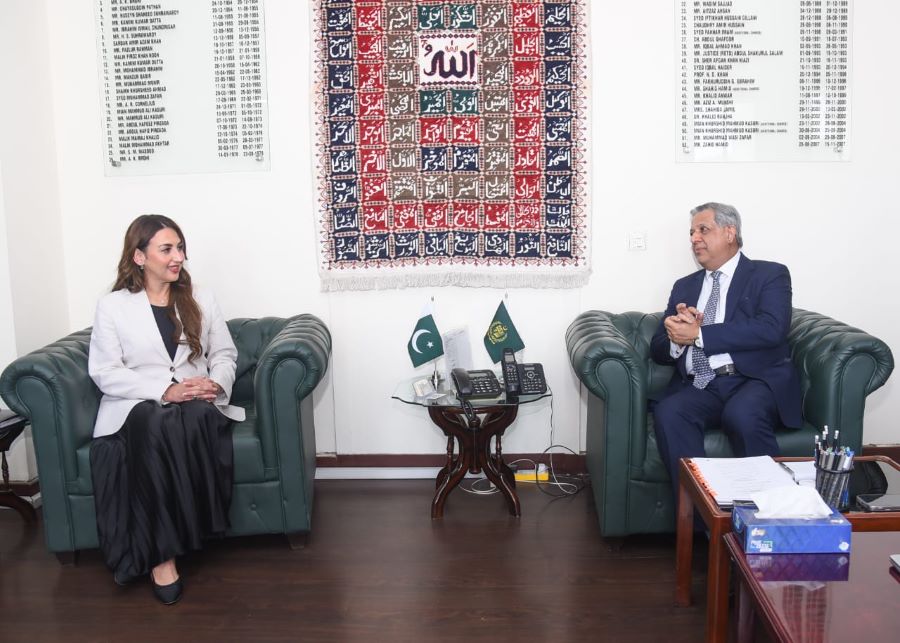
Islamabad, 06 August , 2026 (Kamran Raja): Federal Minister for Law, Justice and Human Rights, Senator Azam Nazeer Tarar, held a meeting with the Chargéd’Affaires of the U.S. Embassy, Natalie A. Baker, at the Ministry of Law, Justice and Human Rights to discuss Pakistan–United States bilateral relations, matters of mutual interest, and the evolving regional situation.During the meeting, Ms. Baker acknowledged Pakistan’s constructive diplomatic role during the recent Gulf conflict and praised the country’s efforts to promote regional peace and stability. She also appreciated the leadership and contributions of Field Marshal Syed Asim Munir and Prime Minister Shehbaz Sharif in supporting diplomatic initiatives aimed at reducing regional tensions.
Senator Tarar reaffirmed Pakistan’s commitment to continuing its constructive engagement in support of regional peace, dialogue, and diplomatic solutions. He emphasized that Pakistan remains committed to promoting stability through peaceful means while maintaining balanced relations with all regional stakeholders. Both sides reiterated their shared commitment to strengthening Pakistan–U.S. cooperation in the legal sector and expanding collaboration in other areas of mutual interest.
Pakistan has increasingly emerged as a balancing force amid Gulf tensions by maintaining strong diplomatic engagement with key regional and international stakeholders. Leveraging its longstanding strategic partnership with Saudi Arabia, close geographic and diplomatic ties with Iran, and constructive relations with the United States, Islamabad has consistently advocated dialogue and de-escalation. The evolving Gulf situation holds direct strategic significance for Pakistan due to its shared border with Iran, deep defence and economic relations with Gulf Cooperation Council (GCC) countries, the presence of millions of Pakistani expatriates across the Gulf, and the country’s energy security requirements.
Recent diplomatic efforts reflect Pakistan’s commitment to facilitating communication between regional rivals and encouraging peaceful resolution of disputes. Key issues influencing regional stability continue to include Iran’s nuclear programme, international sanctions, maritime security in the Strait of Hormuz, and broader security guarantees. Analysts believe Pakistan’s strength lies in its ability to maintain working relationships with multiple parties simultaneously rather than exercising direct influence over any one actor. Its established diplomatic, military, and economic ties with Washington, Tehran, Riyadh, other Gulf capitals, and Beijing provide Islamabad with a unique platform to encourage dialogue and confidence-building. Pakistan has historically played an important role in facilitating communication between rival powers, including during the early 1970s U.S.–China rapprochement. While today’s geopolitical environment differs significantly, that legacy continues to reinforce Pakistan’s reputation as a credible diplomatic interlocutor capable of supporting regional stability through engagement rather than confrontation.