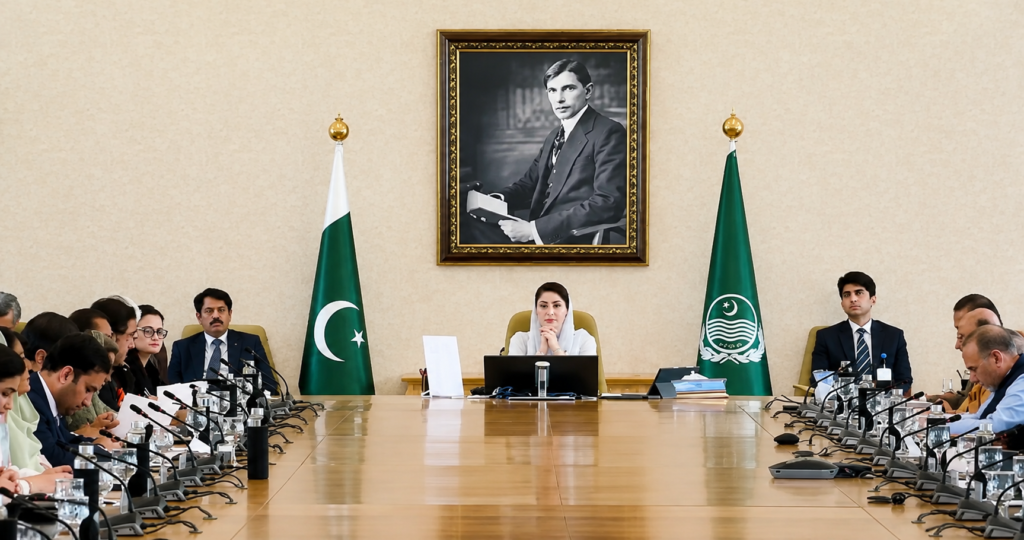
Lahore, August 6, 2026 (Kamran Raja): The 36th meeting of the Punjab Provincial Cabinet was held under the chairmanship of Chief Minister Maryam Nawaz Sharif, where a wide range of decisions were taken to strengthen governance, improve public services, enhance security, and accelerate development across the province. The cabinet congratulated the leadership of the Pakistan Muslim League (N) on its victory in the Azad Jammu and Kashmir elections. Chief Minister Maryam Nawaz Sharif expressed gratitude to the people of AJK for placing their trust in the leadership of Muhammad Nawaz Sharif, stating that the election results reflected public confidence in the party’s vision of development and good governance. Highlighting improvements in law and order, the Chief Minister announced that kidnapping for ransom in the Katcha area had been eliminated after nearly three decades. She noted that crime in the region has remained at zero since last November and praised the efforts of the Punjab Police. The cabinet approved Rs1.1 billion for modern weapons and protective equipment for police personnel deployed in the Katcha area, along with a hard area allowance and relaxation of rules to extend martyr packages to police personnel who sacrifice their lives in the line of duty. The successful organization of the first-ever cricket tournament in the Katcha region was also appreciated.
To encourage youth participation in law enforcement, the cabinet approved a special concession package for police recruitment applicants. The meeting reviewed progress under the “Apna Khet Apna Rozgar” initiative, under which allotment letters for 30,000 agricultural lots have already been issued. Out of 171,000 applicants, around 60,000 were declared eligible. Chief Minister Maryam Nawaz directed authorities to continue encouraging wheat cultivation across Punjab and expressed concern over perceptions of wheat shortages despite a good harvest. The cabinet approved the recruitment of 900 Union Council Secretaries across the province and directed that the Literacy Department be merged with the School Education Department under the supervision of the Provincial Education Minister. The Chief Minister also sought a comprehensive report on government-owned shops across Punjab. The cabinet congratulated Punjab’s students and teachers for maintaining a transparent examination system. Special appreciation was extended to the daughter of a government school teacher for securing the top position in the matriculation examinations. Chief Minister Maryam Nawaz also welcomed the fact that girls accounted for 78 percent of the top-performing matriculation students.
The cabinet commended the provincial administration for proactive measures taken to address monsoon rains and urban flooding. The Chief Minister particularly praised Special Assistant Shoaib Mirza for ensuring timely drainage arrangements during heavy rainfall. Reaffirming her commitment to modern public transportation, Maryam Nawaz announced that electric buses would be extended to every district and tehsil of Punjab. She further declared that 1,100 electric buses would be introduced across the province by December. The cabinet also appreciated the exemplary security arrangements made during Ashura and Chehlum, commending the Cabinet Committee, Provincial Ministers Khawaja Salman Rafique and Bilal Yasin, Home Secretary Qazi Ahmad Javed, and the entire team for their dedicated efforts.
The meeting welcomed the recognition of Punjab’s prison reforms at a Supreme Court seminar and praised Home Secretary Qazi Ahmad Javed for his contributions. Similarly, Provincial Minister Khawaja Imran Nazir and Secretary Nadia Saqib were appreciated for implementing reforms in the Population Welfare Department. The cabinet reviewed the National Wheat Policy 2026–2030, focusing on strategic reserves and stock management. It also agreed to establish a four-member ministerial committee to finalize matters relating to the Medical Entry Test. Concluding the meeting, Chief Minister Maryam Nawaz Sharif emphasized the importance of encouraging both foreign and domestic investment in Punjab, stating that economic growth depends on creating a business-friendly environment while continuing reforms in governance, public services, and infrastructure.