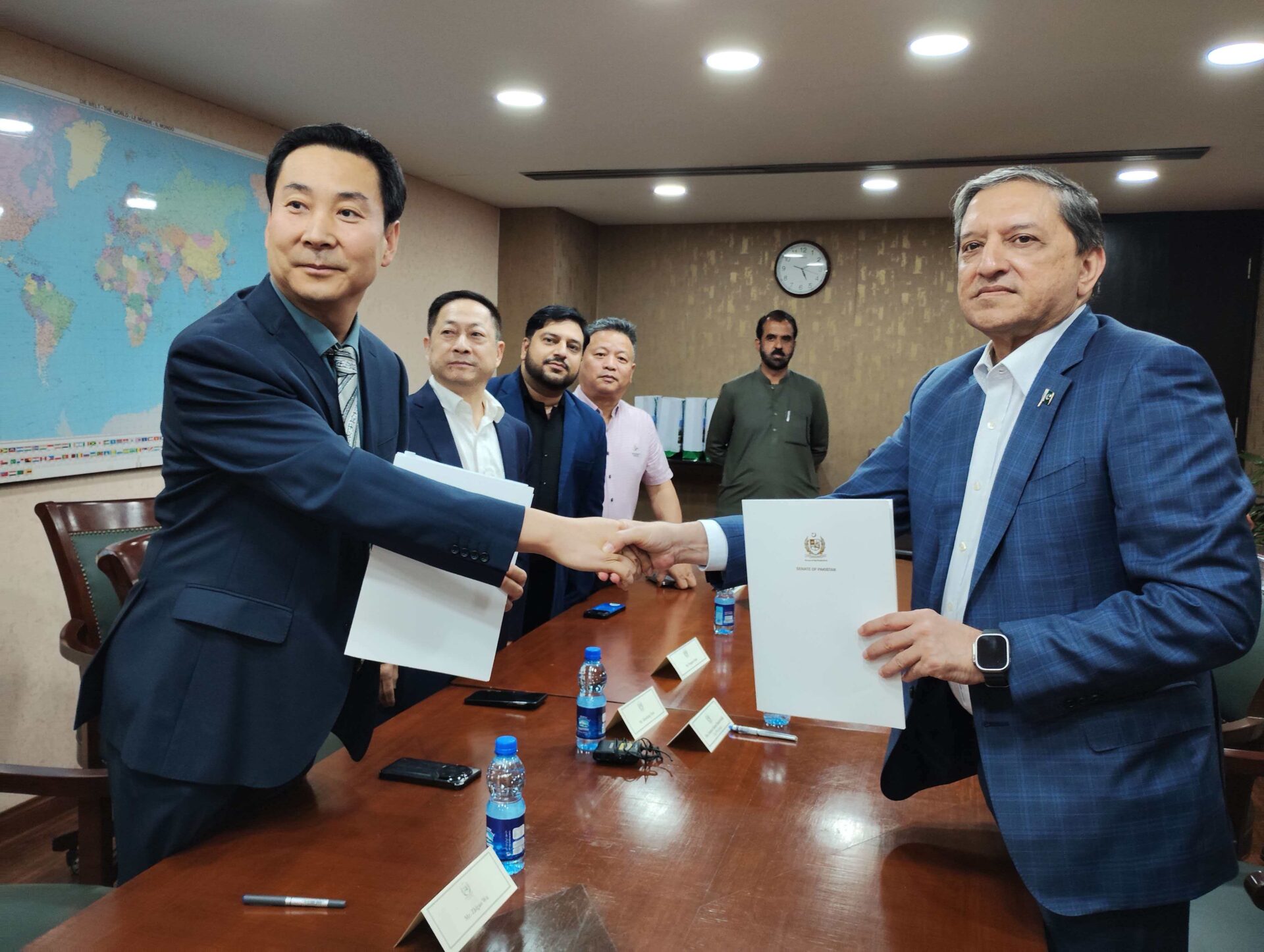
Islamabad 15 June 2026(Kamran Raja):In a significant development aimed at advancing international peace, cultural diplomacy, and people-to-people connectivity, Senator Saleem Mandviwalla, Chief Whip of the Senate of Pakistan and Chairman of the Senate Standing Committee on Finance and Revenue, signed two important Memorandums of Understanding (MoUs) with representatives of Zhongping Technology Co., Ltd. and the World Peace Bottle Forum Organizing Committee.
The agreements mark a major step toward enhancing cooperation between Pakistan and China in the fields of peacebuilding, intercultural dialogue, cultural exchange, international cooperation, and sustainable development. The signing ceremony was attended by distinguished representatives from both countries, reflecting the growing importance of non-governmental and cultural diplomacy in strengthening bilateral relations.
The first agreement, titled “Cooperation and Joint Hosting of the Global 500 Peace Bottle Forum through Joining Standing Council Member Units,” establishes a framework for collaboration in organizing international peace forums and promoting dialogue among nations. The proposed Global 500 Peace Bottle Forum is envisioned as a prestigious international platform that will bring together political leaders, diplomats, business executives, scholars, cultural experts, youth representatives, and civil society organizations from around the world.
The forum aims to promote peace, friendship, mutual understanding, and cooperation among nations while encouraging constructive dialogue on global challenges. Under the agreement, the parties will jointly organize international conferences, exhibitions, cultural festivals, investment forums, business networking events, and educational seminars. These activities are expected to facilitate collaboration in education, tourism, trade, culture, technology, and social development.
The second MoU, titled “Cooperation in the Donation and Installation of the World Peace Bottle Monument,” focuses on the installation of a symbolic monument in Pakistan that will serve as a lasting representation of peace, harmony, friendship, and intercultural understanding.
The proposed World Peace Bottle Monument is expected to become an important cultural landmark, symbolizing humanity’s collective aspiration for peace and cooperation. The monument will not only stand as a physical structure but also serve as a venue for peace-related activities, cultural programs, educational events, and international exchanges.
Speaking on the occasion, Senator Saleem Mandviwalla welcomed the initiatives and described them as important contributions toward strengthening cultural diplomacy and international cooperation.
“Dialogue, mutual respect, and understanding among nations are essential in addressing contemporary global challenges. Such initiatives create opportunities for people from different backgrounds to connect, learn from each other, and work together for a peaceful future.
Senator Mandviwalla’s role in facilitating these agreements as a positive example of parliamentary diplomacy. His efforts highlight the growing importance of cultural and social engagement in modern international relations, complementing traditional diplomatic and economic cooperation.
Zhongping Technology Co., Ltd. has emerged as an active participant in initiatives that seek to combine technological innovation with international cultural cooperation. Chinese enterprises increasingly play an important role in supporting global exchanges and development initiatives, recognizing that economic progress and social harmony are closely interconnected.
The company’s participation in the Peace Bottle Forum demonstrates the Chinese private sector’s commitment to promoting international understanding and fostering cooperation beyond commercial interests. Through partnerships involving cultural exchanges, educational programs, and peace initiatives, organizations such as Zhongping Technology contribute to building stronger connections between nations.
The signing of these agreements gains additional significance within the broader context of the longstanding friendship between Pakistan and China. For more than seven decades, the two countries have maintained one of the strongest and most stable bilateral relationships in the world.
Often described as an “All-Weather Strategic Cooperative Partnership,” Pakistan-China relations have expanded from diplomatic cooperation to encompass economic development, infrastructure construction, trade, investment, education, technology, defense collaboration, and cultural exchanges.
The relationship has been built upon mutual trust, respect, and support on regional and international issues. Successive governments in both countries have consistently prioritized strengthening bilateral cooperation, resulting in numerous landmark projects that have transformed Pakistan’s economic landscape.
Among the most notable achievements is the China-Pakistan Economic Corridor (CPEC), widely regarded as the flagship project of China’s Belt and Road Initiative. Through CPEC, billions of dollars have been invested in Pakistan’s energy, transportation, telecommunications, and industrial sectors.
Major infrastructure projects have improved connectivity across Pakistan, while new energy projects have contributed significantly to reducing electricity shortages and supporting economic growth. The development of Gwadar Port has further enhanced Pakistan’s strategic importance by positioning it as a gateway connecting regional and international trade routes.
Beyond infrastructure, educational cooperation between the two countries has expanded significantly. Thousands of Pakistani students have benefited from scholarships and academic opportunities at Chinese universities, helping to build long-term people-to-people connections.
While economic cooperation remains a cornerstone of Pakistan-China relations, cultural diplomacy is increasingly becoming an important pillar of bilateral engagement. Cultural exchanges help foster mutual understanding, reduce misconceptions, and create stronger bonds between societies.
Initiatives such as the Global 500 Peace Bottle Forum and the World Peace Bottle Monument represent a new chapter in Pakistan-China cooperation. They focus on strengthening human connections through dialogue, cultural interaction, educational collaboration, and shared values.
Experts believe that sustainable international partnerships require strong social and cultural foundations. Economic cooperation alone cannot fully realize the potential of bilateral relations without meaningful engagement between peoples and communities.
The newly signed agreements reflect a shared commitment to promoting peace, harmony, and international friendship. At a time when many regions face geopolitical tensions and uncertainty, initiatives encouraging dialogue and cooperation are increasingly valuable.
For Pakistan, hosting international peace forums and cultural initiatives offers opportunities to enhance its global image, attract international engagement, promote tourism, and facilitate educational and business partnerships. Such activities can also contribute to strengthening Pakistan’s role as a bridge between cultures and civilizations.
Political analysts and observers have welcomed Senator Saleem Mandviwalla’s leadership in advancing these initiatives, describing them as forward-looking efforts that combine diplomacy, culture, and international cooperation. His support for these agreements demonstrates a recognition that lasting peace is built not only through political agreements but also through cultural understanding and people-to-people connections.
As Pakistan and China continue to deepen their strategic partnership, initiatives promoting cultural diplomacy and international dialogue are expected to play an increasingly important role. The signing of these two MoUs therefore represents more than a ceremonial occasion it symbolizes a shared vision for peace, friendship, and cooperation between nations.
The agreements are expected to contribute positively to strengthening Pakistan-China relations while promoting the universal values of peace, mutual respect, and intercultural understanding for future generations.