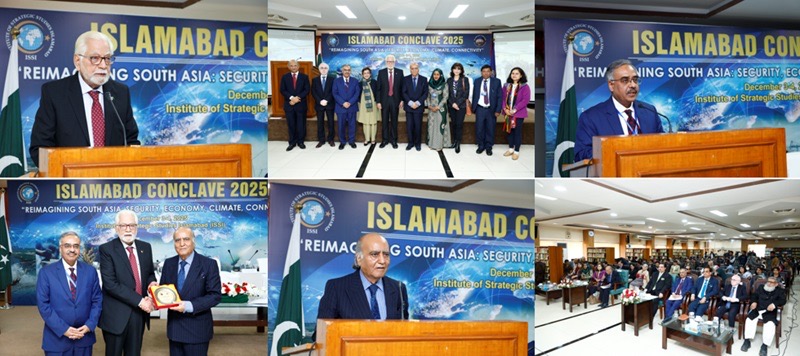
Islamabad 5 December 2025(Nosheen): The 5th Edition of Institute of Strategic Studies Islamabad (ISSI)’s annual Dialogue Forum, Islamabad Conclave, concluded after wide-ranging and absorbing deliberations. The thematic focus of this edition was, “Re-imagining South Asia: Security, Economy, Climate, Connectivity.” Former Foreign Minister of Pakistan, Ambassador Inam ul Haque, was the Chief Guest at the concluding plenary.
During the session, Director General ISSI, Ambassador Sohail Mahmood, presented Key Takeaways from the Inaugural and five Working Sessions held over the two days.
In his comprehensive presentation, Director General ISSI Ambassador Sohail Mahmood noted that all the speakers and participants agreed that “re-imagining South Asia” was a very pertinent and timely theme. He added that the Conclave’s deliberations reaffirmed the view that South Asia’s persistent deficits in security, development, and regional cooperation continued to limit the region’s ability to realize its full potential. Escalating geopolitical tensions, unresolved disputes, nuclear and conventional build-ups, and crises such as those witnessed in May 2025 demonstrate the fragility of regional stability. The key message that emerged from the 2-day Conclave, Ambassador Sohail Mahmood noted, was that the region must shift the paradigm from confrontation to cooperation, from zero-sum approaches to win-win frameworks, and embrace a reimagined South Asia rooted in institutionalized cooperation, connectivity, economic integration, and climate resilience. The discussions emphasised the importance of moving beyond bloc politics, promoting dialogue, strengthening multilateralism, and addressing shared human and environmental challenges through collective strategies.
Ambassador Sohail Mahmood further stressed that countries in the region had the agency to “re-imagine” South Asia and change the existing reality for the better. He also recalled the key message delivered by Deputy Prime Minister and Foreign Minister Senator Mohammad Ishaq Dar that it was imperative to fundamentally re-think the regional cooperation architecture to adapt it to new realities and pragmatically promote constructive collaboration through new formats with ‘variable geometry.’
Ambassador Sohail Mahmood ended his remarks by expressing deep appreciation for the entire ISSI team, as this Conclave marked his last in the capacity of Director General ISSI since he would move to a different responsibility in January 2026. “It has been a great privilege and honour to serve as DG ISSI for the last three years and I am grateful for the invaluable support I received from the Chairman BoG, Research Faculty, and all the staff members,” he concluded.
In his address on the occasion, Chief Guest Ambassador Inam ul Haque commended ISSI for convening a timely and substantive discourse on South Asia’s evolving geopolitical, economic, and environmental realities. He presented a wide-ranging and deeply analytical reflection on the evolving global order and its implications for South Asia. He observed that the contemporary international environment is shaped by rapid geopolitical shifts, emerging economic patterns, and accelerated technological transformation. These developments, he emphasised, require states particularly developing economies, to cultivate strategic foresight, reinforce institutional resilience, and pursue diversified diplomatic partnerships. Ambassador Inam ul Haque noted that long-term global transitions must be assessed with clarity and steadiness, rather than through the lens of short-term policy debates or periodic changes in leadership.
On the evolving global order, he noted that the U.S. still remained the preeminent power, while China was rising and Russia re-surging. He stressed that it was not yet clear whether the global order would finally culminate in a unipolar world, a G2, or multi-polarity.
Addressing major-power relations, Ambassador Inam ul Haque highlighted the importance of maintaining balanced, constructive, and mutually respectful engagement with all partners while safeguarding national interests. He reaffirmed the enduring value of Pakistan’s strategic and time-tested partnership with China, describing it as a relationship anchored in reliability, shared development priorities, and a strong record of cooperation especially in connectivity, technological collaboration, and economic modernization. At the same time, he underscored that Pakistan continues to benefit from productive ties with Western countries and other global actors, and must sustain a pragmatic, future-oriented approach that advances its broader diplomatic and economic objectives.
Turning to South Asia, Ambassador Inam ul Haque provided a measured assessment of the region’s challenges, noting limited economic integration, insufficient connectivity frameworks, and the absence of a durable cooperative security architecture. He stressed that a prosperous and interconnected South Asia requires stronger regional institutions, inclusive growth strategies, and a sustained focus on human-centred development, including climate resilience, economic diversification, and digital capacity-building. Ambassador Inam ul Haque called for forward-looking regional cooperation that leverages the region’s demographic advantages and translates them into shared stability and prosperity.
Concluding, he stressed the absolute necessity of internal consolidation — including the imperatives to build a strong economy, control population growth, address deficits in health sector, make critical investments in the revitalisation of education system, and improve overall governance. He strongly stressed that addressing the challenges on the internal front must remain highest priority.
Presenting the Vote of Thanks, Ambassador Khalid Mahmood, Chairman Board of Governors ISSI, expressed gratitude to all distinguished speakers, panelists, and participants for their valuable contributions. Reflecting briefly on the broader global context, he noted that while the traditional international order is gradually eroding, a new order has yet to consolidate leaving the world in a period of transition and uncertainty. He observed that the Conclave successfully captured these complex dynamics while offering forward-looking insights on South Asia’s geopolitical and geo-economic trajectory. He thanked regional and international participants for enriching the dialogue and conveyed appreciation to the Director General and the ISSI team for their dedication and professionalism in organising the Conclave.
The Conclave brought together a diverse audience, including members of the diplomatic corps, academia, think-tank community, civil society, policy practitioners, students, and media representatives. The two-day event affirmed a renewed call for collaborative approaches to regional peace, stability, and shared development in South Asia.