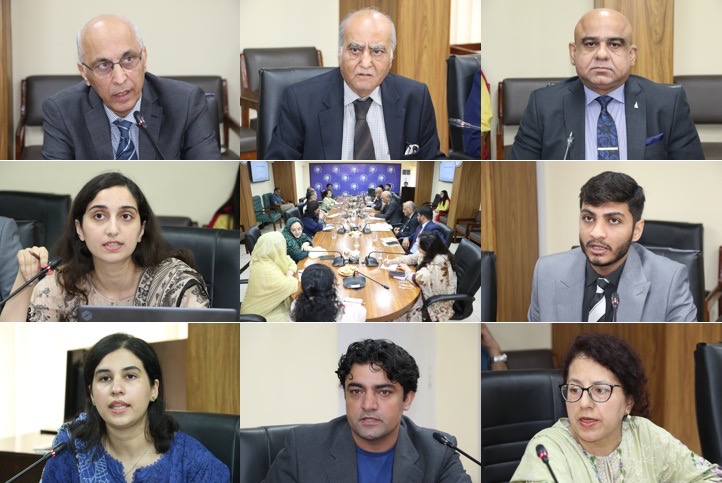
Islamabad, September 6, 2026(Nosheen): The Arms Control and Disarmament Centre (ACDC) at the Institute of Strategic Studies Islamabad (ISSI) organized an in-house meeting today to commemorate Pakistan Defence Day. The event brought together members of ISSI to reflect on the historic significance of the day, pay tribute to the martyrs of Pakistan’s Armed Forces, and examine the evolution of the country’s defence architecture across conventional, nuclear, and space domains.
Addressing the gathering, Ambassador Moin ul Haque, Director General ISSI, paid rich tribute to the valour and sacrifices of Pakistan’s Armed Forces and the martyrs who laid down their lives in defence of the country’s sovereignty and territorial integrity. He stated that Pakistan’s acquisition of nuclear capability restored strategic balance in South Asia and established full-spectrum deterrence as a cornerstone of national security.
Appreciating the presentations on Pakistan’s air capabilities, indigenization efforts, nuclear forces, and space programme, Ambassador Haque emphasized that national defence extends beyond geographical frontiers. He underscored that national defence is a multidimensional endeavour encompassing conventional preparedness, technological advancement, economic strength, national cohesion, strategic clarity, and resilience. He further stressed the importance of personal sacrifice, unity, discipline, and hard work across all segments of society, including researchers, diplomats, doctors, teachers, and other professionals, working collectively with the Armed Forces in strengthening the nation under the enduring principles of Quaid-e-Azam Muhammad Ali Jinnah: Unity, Faith and Discipline.
Earlier, in his introductory remarks, Malik Qasim Mustafa, Director ACDC, highlighted the enduring significance of Defence Day as a symbol of national resilience, unity, and strategic resolve. He noted that the day serves as a reminder that the defence of Pakistan is not solely the responsibility of the Armed Forces but remains a shared national responsibility.
Speaking on Pakistan’s space programme, Mahzaib Khan, Research Associate, ACDC, highlighted the growing importance of space technology for scientific research, national security, and socioeconomic development. She noted that Pakistan’s space programme has evolved considerably since its early work in upper-atmospheric research and sounding rocket launches in the 1960s, progressing towards communication and remote-sensing capabilities. She also underscored the importance of international cooperation, particularly Pakistan’s longstanding partnership with China, in advancing the country’s space capabilities.
Muhammad Shahzaib Hassan, Research Assistant, ACDC, traced the evolution of the Pakistan Air Force from its performance during the 1965 war, where preparedness, training, and tactical leadership served as critical force multipliers, to the contemporary high-technology and networked combat environment. He highlighted Pakistan’s transition from reliance on imported platforms towards modernization, indigenization, and network-centric warfare.
Ramsha Ashraf subsequently presented an overview of Pakistan’s nuclear force architecture and strategic delivery capabilities. She highlighted Pakistan’s diversified nuclear deterrent, comprising established land- and air-based capabilities alongside an emerging sea-based component, under the doctrine of Full Spectrum Deterrence aimed at deterring aggression at both tactical and strategic levels.
In his concluding remarks, Ambassador Khalid Mahmood, Chairman, Board of Governors (BOG), ISSI, underscored that Pakistan’s development of robust conventional and nuclear capabilities has played a vital role in safeguarding national sovereignty and maintaining strategic stability in the region. Referring to the events of May 2025, he stated that they dispelled dangerous assumptions regarding a possible “new normal” of cross-border strikes and demonstrated Pakistan’s resolve to respond firmly to acts of aggression.
While emphasizing that sustainable peace requires strategic equilibrium and credible deterrence, Ambassador Mahmood reaffirmed Pakistan’s commitment to peaceful coexistence, dialogue, and result-oriented diplomacy. He also appreciated the ACDC and ISSI research team for their continued efforts to provide rigorous and informed analysis on issues relating to national security and strategic stability.
The meeting concluded with a reaffirmation of the importance of national unity, institutional resilience, technological advancement, and strategic preparedness in safeguarding Pakistan’s sovereignty and promoting peace and stability in the region.