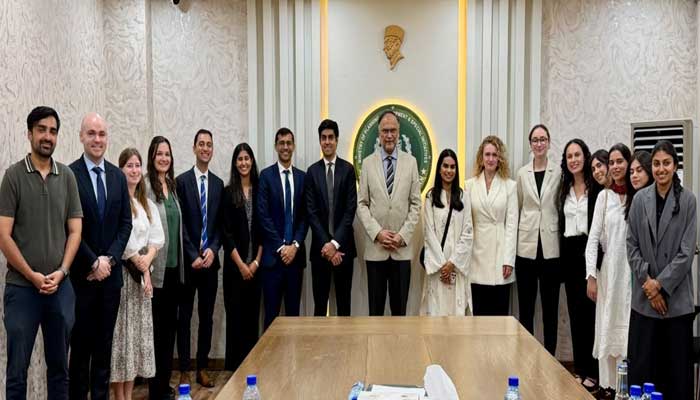
ISLAMABAD, 29 August, 2026 (Kamran Raja): Federal Minister for Planning, Development and Special Initiatives Ahsan Iqbal has said Pakistan’s central economic challenge is to transform macroeconomic stability into sustained growth, higher productivity, increased exports, investment and employment. Addressing a visiting delegation of Harvard Business School MBA students at the Ministry of Planning and Development on Friday, Iqbal said Pakistan should not be viewed only through the lens of its challenges but through the scale of its economic and human potential. He highlighted Pakistan’s large population, young workforce, strategic geographic location, agricultural and mineral resources, expanding digital economy and global diaspora as important foundations for long-term economic transformation. The minister said Pakistan must break the recurring cycle of economic expansion, external account pressures, stabilisation and slowdown by restructuring the economy around productivity and exports. “Stabilisation is necessary, but stabilisation alone is not development,” Iqbal said, stressing that sustainable prosperity required productivity, innovation, investment and exports. The minister briefed the students on URAAN Pakistan, the government’s national transformation framework based on the five Es: exports, enterprise and employment; e-Pakistan and the digital economy; environment, climate change, food and water security; energy and infrastructure; and equity, ethics and empowerment. Iqbal said Pakistan had set an ambition of becoming a $1 trillion economy by 2035, but emphasized that the goal was not merely to achieve a numerical GDP target.He said the key question was what Pakistan would be capable of producing and selling competitively in global markets by 2035 that it could not produce today. He stressed that development ultimately depended on building national capabilities.
The planning minister identified productivity, quality and innovation as critical factors for Pakistan’s future competitiveness. He said the government was seeking to develop a national culture around Productivity, Quality and Innovation (PQI) so that “Made in Pakistan” would increasingly become associated with reliability, quality and value in international markets. Highlighting the importance of human capital, Iqbal said Pakistan’s people were its greatest resource. He warned that a young population could become a demographic liability if it was not supported by quality education, nutrition, healthcare, skills and employment opportunities. He described human capital as the country’s most important infrastructure, saying advanced economies derived their long-term strength not only from physical assets but also from universities, research institutions and innovation ecosystems. Discussing emerging technologies, Iqbal said artificial intelligence presented a historic opportunity for developing economies. However, countries that failed to develop technological capabilities risked falling behind in a new global intelligence divide. He said Pakistan must move beyond being a consumer of emerging technologies and become a producer and adapter of technologies in fields including artificial intelligence, biotechnology, advanced manufacturing, agriculture and space sciences. On climate change, the minister said Pakistan’s experience had demonstrated that climate resilience could no longer be treated as a separate environmental issue, as it directly affected fiscal stability, food security, infrastructure, public health and poverty. He also highlighted the evolving role of the China-Pakistan Economic Corridor (CPEC), saying its first phase had focused substantially on infrastructure and energy, while the next phase should increasingly emphasize industrial cooperation, technology transfer, agriculture, exports and business-to-business partnerships. Addressing the political economy of reforms, Iqbal stressed the importance of policy continuity over an extended period.He said successful nations might follow different economic models, but they shared one common characteristic: continuity of direction. Sustainable economic development, he added, required good policies to be implemented consistently over time.