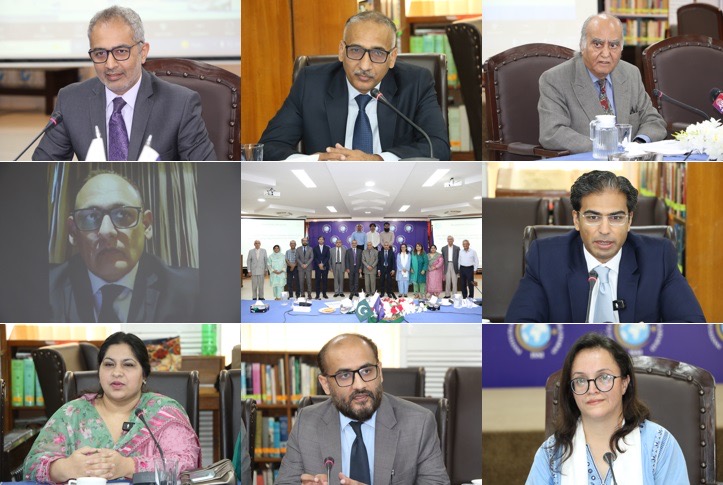
 Islamabad, 28th April 2026(Nosheen): The Institute of Strategic Studies Islamabad (ISSI), in collaboration with Policy Research Institute of Market Economy (PRIME), hosted a roundtable discussion on “The Middle East Crisis: Economic Implications and Emerging Opportunities for Pakistan,” on April 28, 2026. The event brought together leading policymakers, economists, and experts to deliberate on the evolving geopolitical situation and its economic ramifications for Pakistan.
Dr. Neelum Nigar, Director, Centre for Strategic Perspectives (CSP) at ISSI, stressed that Pakistan faces both heightened risks and emerging opportunities, and must strengthen its capacity to adapt to an increasingly complex global economic environment.
Ambassador Khalid Mahmood, Chairman Board of Governors, ISSI, in his welcome remarks, highlighted that the evolving Middle East situation carries significant implications for Pakistan, particularly in the domains of energy security, trade flows, remittances, and overall economic stability. While Dr. Ali Salman, CEO, PRIME, in his stage-setting remarks, highlighted the growing convergence between geopolitics and economics, noting that the current crisis underscores the relevance of geoeconomics in shaping policy discourse. He pointed to emerging regional developments, including new transit arrangements and shifting diplomatic engagements, as indicators of Pakistan’s evolving strategic positioning. He emphasised that Pakistan must now move beyond traditional conflict-driven narratives and instead focus on deriving a peace dividend through proactive economic and diplomatic engagement. He outlined key thematic areas for discussion, including economy, energy, trade, China–Pakistan cooperation, and policy preparedness.
Opening the discussion, Dr. Hassan Dawood Butt (PRIME) noted that Pakistan is increasingly being perceived as a potential regional intermediary, while cautioning that without deep institutional reforms, the country may be unable to fully capitalize on this emerging role. Dr. Nasir Iqbal (PIDE) outlined macroeconomic risks including rising oil prices, inflationary pressures, declining remittances, and export disruptions, while also pointing to potential opportunities in Gulf reconstruction markets. Dr. Khaled Waleed (SDPI) highlighted structural weaknesses in Pakistan’s energy sector, calling for modernization of the power grid, expansion of renewable energy, and improved energy storage capacity. Dr. Uzma Zia (PIDE) emphasized the need to transition from remittance dependence toward a diversified economic model anchored in trade, logistics, and regional connectivity, including modernization of ports and development of integrated economic corridors. Dr. Vaqar Ahmed (PRIME) pointed to governance and coordination challenges, stressing the need for stronger institutional frameworks, improved data sharing, strategic reserves, and proactive economic diplomacy
Experts collectively underscored several key policy directions emerging from the discussion:
Pakistan must undertake a governance and policy reset to better convert external shocks into structured economic opportunities and improve overall crisis preparedness.
Re-engagement with multilateral frameworks, including the IMF, was seen as necessary, with emphasis on securing a more balanced programme aligned with long-term structural reforms and growth objectives.
Participants cautioned that Pakistan’s external account remains under pressure, particularly as remittances from the Middle East may face volatility amid regional instability.
At the same time, speakers identified emerging opportunities in shifting regional connectivity patterns, stressing that Pakistan’s private sector must position itself to benefit from new transit and trade routes, including evolving linkages through Iran and adjacent corridors.
A strong emphasis was placed on infrastructure readiness, with calls for strategic investment in port infrastructure—particularly Karachi and Gwadar—to capture growing transshipment and logistics opportunities in a reconfiguring regional trade landscape.
The roundtable concluded with a consensus that while the Middle East crisis presents significant risks to Pakistan’s economy, it also offers a narrow but important window for structural reform, governance strengthening, and strategic economic repositioning—provided timely and coordinated policy action is undertaken.