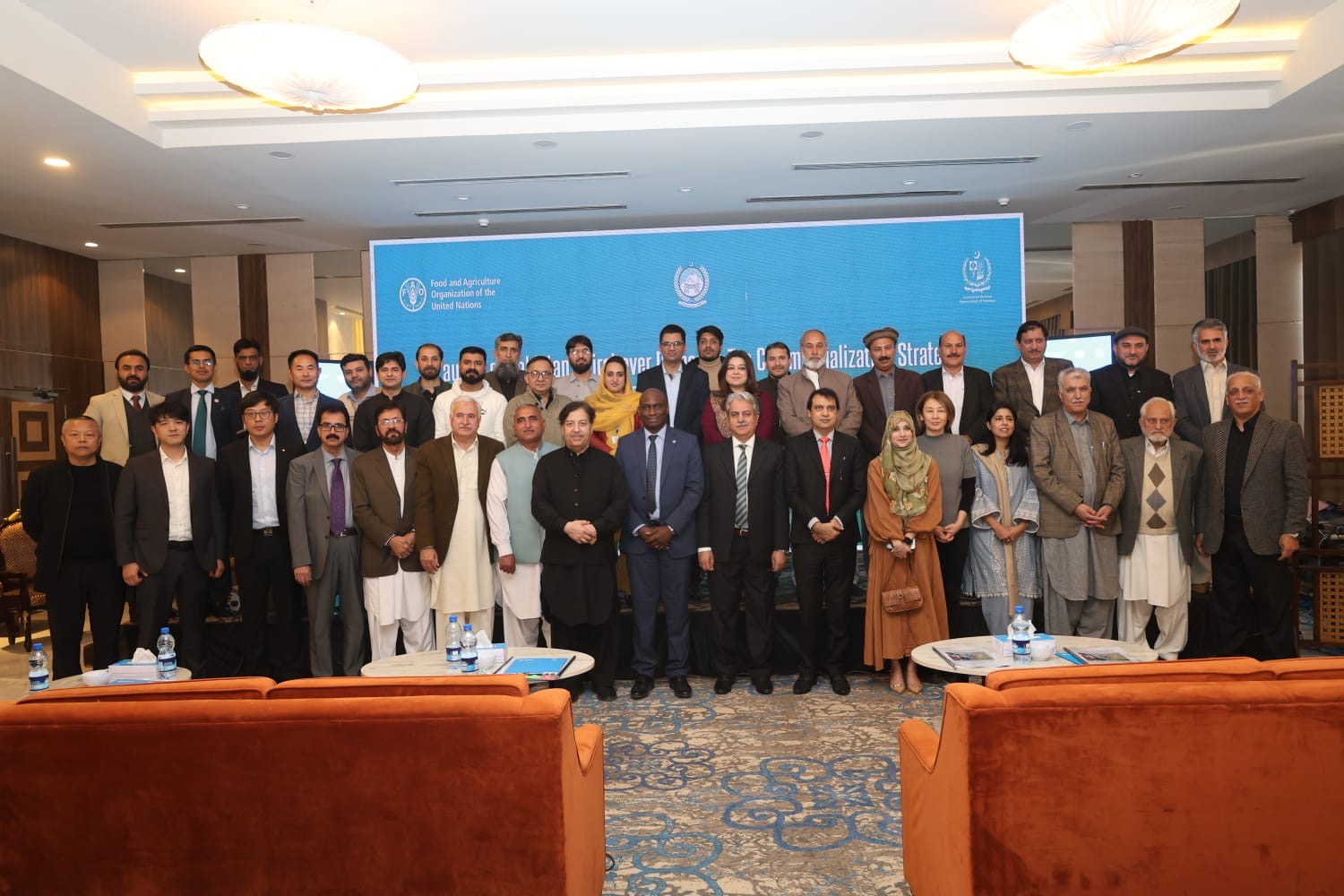
 Islamab 11 December 2025(Kamran Raja): The Food and Agriculture Organization of the United Nations (FAO), in collaboration with the Government of Pakistan, today launched the country’s first-ever Domestic Tea Commercialization Strategy, marking a historic milestone in Pakistan’s journey toward establishing a self-sustaining national tea industry.
The launch event, held at a local hotel in Islamabad, brought together federal and provincial leaders, development partners, national and international technical experts, tea growers, and private-sector representatives reflecting Pakistan’s strong national commitment and FAO’s leadership in developing this emerging sector.
Pakistan currently spends over USD 600 million each year on tea imports. Supported technically by FAO under its Tea Technical Cooperation Programme, the new strategy provides a comprehensive roadmap to gradually reduce import dependence by promoting climate-smart, locally produced tea primarily in Khyber Pakhtunkhwa. The initiative aims to generate new livelihood opportunities, diversify rural economies, and establish a modern, high-value, vertically integrated tea industry.
The strategy’s first phase will begin in Mansehra district, where 600 acres will be cultivated with 2.4 million nursery-grown tea plants. FAO-led training will enable farmers to adopt modern, climate-resilient cultivation techniques. To maintain quality and reduce post-harvest losses, small and efficient processing units will be set up near plantation sites. Additionally, interest-free government financing will support farmers in adopting tea as a long-term sustainable crop.
By 2030, Mansehra’s tea area is projected to produce 2,500 metric tons of green leaf annually and generate more than 2,000 jobs. As the industry grows, over 70,000 rural residents are expected to benefit by 2040.
Speaking at the launch, Mr. Ahsan Iqbal, Federal Minister for Planning, emphasized Pakistan’s unique opportunity to build a tea industry “from the ground up”one grounded in quality, environmental sustainability, climate resilience, and enhanced women’s economic participation. He highlighted wide-ranging benefits, including soil conservation, carbon sequestration, eco-tourism development, and future possibilities for local tea branding.
Mr. James Okoth, FAO Acting Representative in Pakistan, underscored the strong FAO Government partnership, which brings together federal ministries, the Khyber Pakhtunkhwa government, national research institutions such as NTHRI, the private sector, and local communities. He emphasized that the strategy aligns with Pakistan’s national development agenda under the pillars of Export, Energy, Environment, E-Pak, and Equity & Empowerment.
Ms. Kiyal Akmatbek, FAO Head of Office in Khyber Pakhtunkhwa, reaffirmed FAO’s sustained support to the Government of Pakistan through technical assistance, farmer training, research collaboration, and facilitation with investors and development partners. “Pakistan’s strong agroclimatic potential, scientific capacity, and farmer readiness position the country well to transition from a tea-importing to a tea-producing nation,” she said.
Addressing the participants online from Canada, Mr. John Snell, FAO International Consultant, highlighted Pakistan’s comparative advantage in producing high-quality orthodox tea. He noted that the global shift particularly among younger consumers from CTC to orthodox tea presents Pakistan with a strategic opportunity to reduce foreign exchange expenditures while generating environmental and economic benefits for agrarian communities and strengthening national supply security.
With the launch of this landmark strategy, Pakistan enters a new era—one where tea is grown by its own farmers, supporting rural livelihoods, advancing climate-smart agriculture, and reducing reliance on imported tea.