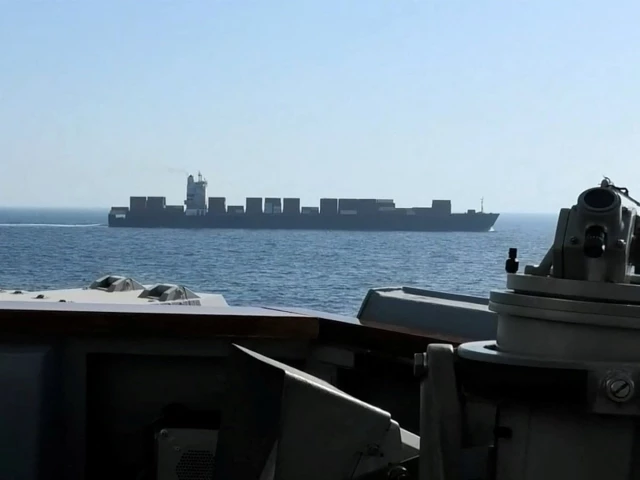
Islamabad, 17 November, 2026 (Nosheen): The United States has increased its naval deployment in the Middle East to levels exceeding those recorded during the height of the US-Israeli war against Iran in February and March, according to an assessment by Israel’s Institute for National Security Studies (INSS). The institute said it analysed publicly available information on American military personnel and naval assets deployed across the Gulf, Arabian Sea, Red Sea and Mediterranean. In its assessment, INSS stated that the current US naval presence was larger than the force deployed during Operation Epic Fury, providing Washington with enhanced offensive capabilities and a wider capacity to intercept missiles. Although the institute did not disclose the exact number of US personnel or warships in the region, its interactive deployment map showed that aircraft carriers George Washington, George H.W. Bush and Theodore Roosevelt are currently operating in the area alongside several other military vessels. The development comes after US President Donald Trump declared on November 9 that the war with Iran was effectively over militarily, while insisting that the US naval blockade would remain in place to maintain economic pressure on Tehran. Despite the expanded naval deployment, American air power stationed at land bases remains below March levels, even though more than 200 aerial refuelling aircraft are present in the region, according to the institute. INSS attributed the decline in forward-based aircraft to their relocation farther west within the Middle East or transfer to Europe, citing the vulnerability of military bases to Iranian attacks. It added that aircraft could be redeployed considerably faster than naval forces, allowing the regional balance of air power to change rapidly. The United States and Israel launched military operations against Iran on February 28, prompting Tehran to retaliate against Israel and what it described as American military facilities in Arab countries. Washington and Tehran had signed a memorandum of understanding in June, but its implementation stalled over disagreements regarding guarantees for freedom and security of navigation through the Strait of Hormuz, a vital international route for energy supplies and commercial goods. Since July, confrontations between the two sides have periodically resumed despite ongoing diplomatic efforts to end the conflict, which has caused significant economic and political repercussions across the region and beyond. Meanwhile, Washington and Tel Aviv have accused Tehran of pursuing nuclear activities that threaten Israel and regional allies, while Iran maintains that its nuclear programme is intended solely for peaceful purposes.