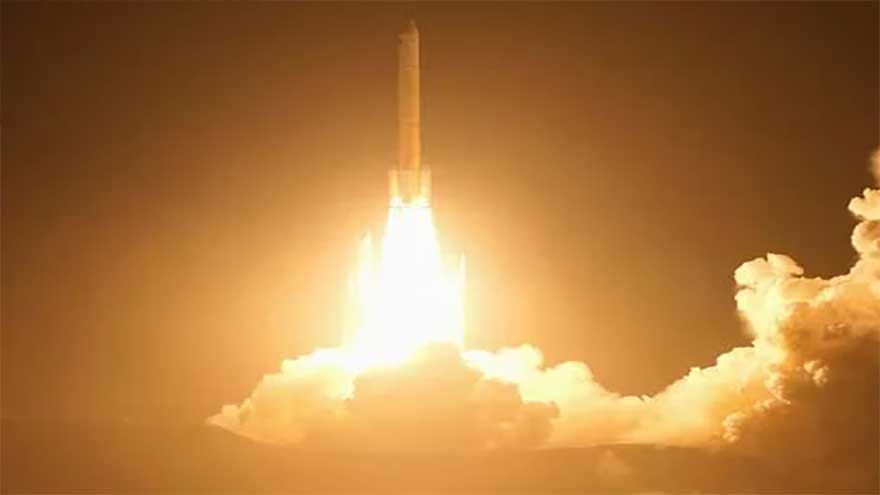
Tokyo, 20 October, 2026 (Kamran Raja): Japan has launched a landmark space mission to collect surface samples from Phobos, one of Mars’ two moons, in an effort to uncover clues about the formation of the Martian moons and the origins of the Solar System. The unmanned Martian Moons eXploration (MMX) spacecraft lifted off aboard an H3 rocket from the Tanegashima Space Centre in southwestern Japan at 4:41 a.m. local time on Tuesday, according to the Japan Aerospace Exploration Agency (JAXA). More than an hour after launch, JAXA confirmed that the spacecraft had successfully separated from the rocket and was heading towards the Martian system, with signals indicating that its systems were operating normally. JAXA scientist Mari Aida expressed her excitement during the mission’s live broadcast, saying she had dreamed of the day for a long time. The spacecraft is expected to reach the vicinity of Mars around August 2027, where it will study the planet’s two moons, Phobos and Deimos, before attempting to collect material from Phobos. Under the mission plan, MMX will spend approximately three years in the Martian region and collect at least 10 grams of surface material from Phobos. The samples will subsequently be returned to Earth for detailed scientific analysis. As part of the mission, a French-German rover named IDEFIX will explore Phobos’ surface before the main spacecraft begins its sampling operations. The rover will examine the moon’s terrain and help scientists identify suitable conditions for a safe landing and sample collection. The mission involves international cooperation among Japan, the United States and European space agencies, along with universities and technology companies. Scientists hope the samples will help resolve a long-standing debate over the origins of Phobos and Deimos. One theory suggests that the moons formed from debris produced when a large celestial object collided with Mars, while another proposes that they are asteroids captured by the planet’s gravitational field. Analysis of material collected from Phobos could help determine which explanation is more likely and improve understanding of the early evolution of Mars and the wider Solar System. JAXA has said the findings could also provide valuable insights into the development of potentially habitable environments on rocky planets, including Earth and Mars.
NASA Science Mission Directorate Administrator Nicky Fox described the mission as an opportunity to advance scientific understanding of the Martian system and support preparations for future human exploration of Mars. Beyond investigating the moon’s origins, MMX will examine whether Phobos could serve as a staging point for future crewed missions to the Red Planet. Studying its environment could help scientists assess its potential for supporting spacecraft operations and overcoming some of the challenges associated with human space exploration. The mission will also observe Deimos, Mars’ smaller outer moon, although the spacecraft will not land on it. Japan’s mission comes amid growing international efforts to bring samples from Mars and its surrounding region back to Earth. NASA’s Perseverance rover has been collecting samples on Mars since 2021, but plans to return them to Earth have faced significant challenges and changes. China is also preparing its Tianwen-3 mission, scheduled for launch around 2028, with the goal of returning Martian samples as early as 2031. Although MMX is designed to collect material from Phobos rather than Mars itself, its findings could provide important information about the planet’s history and the evolution of its moons. The successful completion of the mission would mark a major milestone in planetary exploration and deepen scientific understanding of the Martian system, while helping pave the way for future robotic and human missions to Mars.