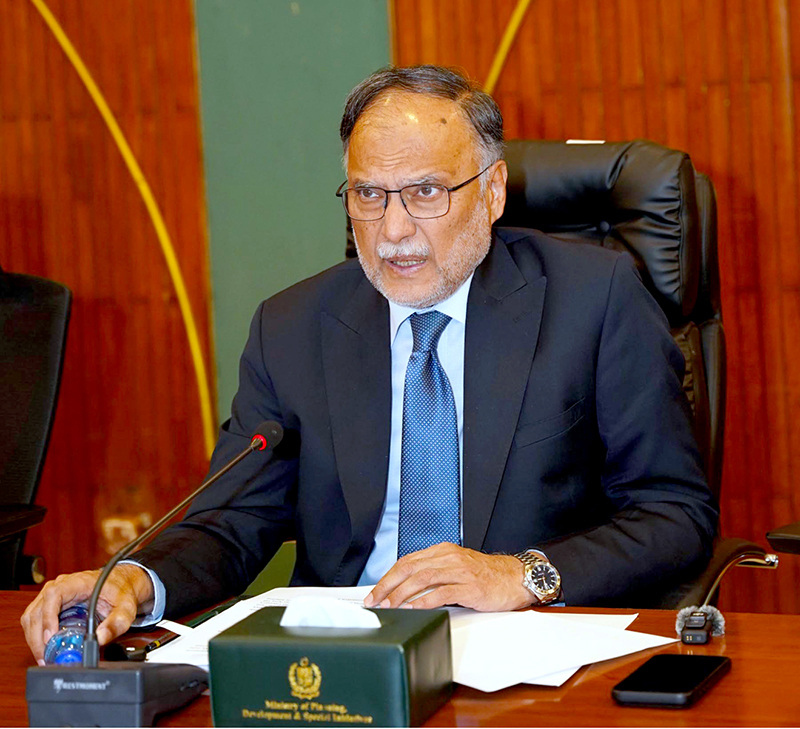
Islamabad, 11 October, 2026 (Kamran Raja): Federal Minister for Planning and Special Initiatives Ahsan Iqbal has said that the China-Pakistan Economic Corridor (CPEC) is entering a new phase of productive partnership, shifting its focus from infrastructure development towards industrial cooperation, business-to-business investment, innovation and regional connectivity. In an article published in China Daily, the minister said Pakistan and China shared an enduring relationship based on mutual trust, respect for each other’s core interests and a common commitment to development and prosperity. He described CPEC as the most visible economic expression of the two countries’ all-weather strategic cooperative partnership and a flagship project of China’s Belt and Road Initiative. Ahsan Iqbal said the first phase of CPEC had delivered 43 completed projects worth approximately $25 billion, including 17 energy projects that added around 8,900 megawatts to Pakistan’s power-generation capacity, alongside two coal mines and the Matiari-Lahore high-voltage transmission line. Major transport projects had improved connectivity, while approximately 200,000 direct jobs had been created. He said CPEC 2.0 would complement Pakistan’s national development framework, URAAN Pakistan, by promoting industrial growth, innovation, green development, livelihoods and regional connectivity. The minister identified industrialisation as a central driver of the new phase, noting that Pakistan offered Chinese businesses a large market, a young workforce, natural resources and access to the Arabian Sea, with the potential to connect production and exports to South Asia, Central Asia, the Middle East and Africa. He emphasised the importance of policy continuity, modern infrastructure, skilled human resources, investment facilitation and technological advancement in attracting sustainable investment. Ahsan Iqbal said the two countries were expanding cooperation in agriculture, mining, artificial intelligence, cloud infrastructure, e-commerce, cybersecurity, digital payments and industrial automation. He also highlighted opportunities for joint AI research, skills development, smart manufacturing, mineral exploration, disaster forecasting, telemedicine and digital education. Proposing a Pakistan-China Knowledge Corridor as a key pillar of CPEC 2.0, the minister stressed that education, technical training and apprenticeships would help prepare young people for regional and global employment opportunities. He further described Gwadar as a strategic component of the corridor’s future, saying efforts were underway to integrate its port and free zone with warehousing, fisheries, processing, tourism, customs services and local businesses to generate greater economic value. Reaffirming Pakistan’s commitment to the safety of Chinese citizens, institutions and projects, Ahsan Iqbal said the success of CPEC depended on sustained implementation and close cooperation between the two countries. He expressed confidence that by 2047, CPEC would leave a lasting legacy of a more capable, innovative and competitive Pakistan, contributing to shared prosperity, regional connectivity and a stronger China-Pakistan community with a shared future.