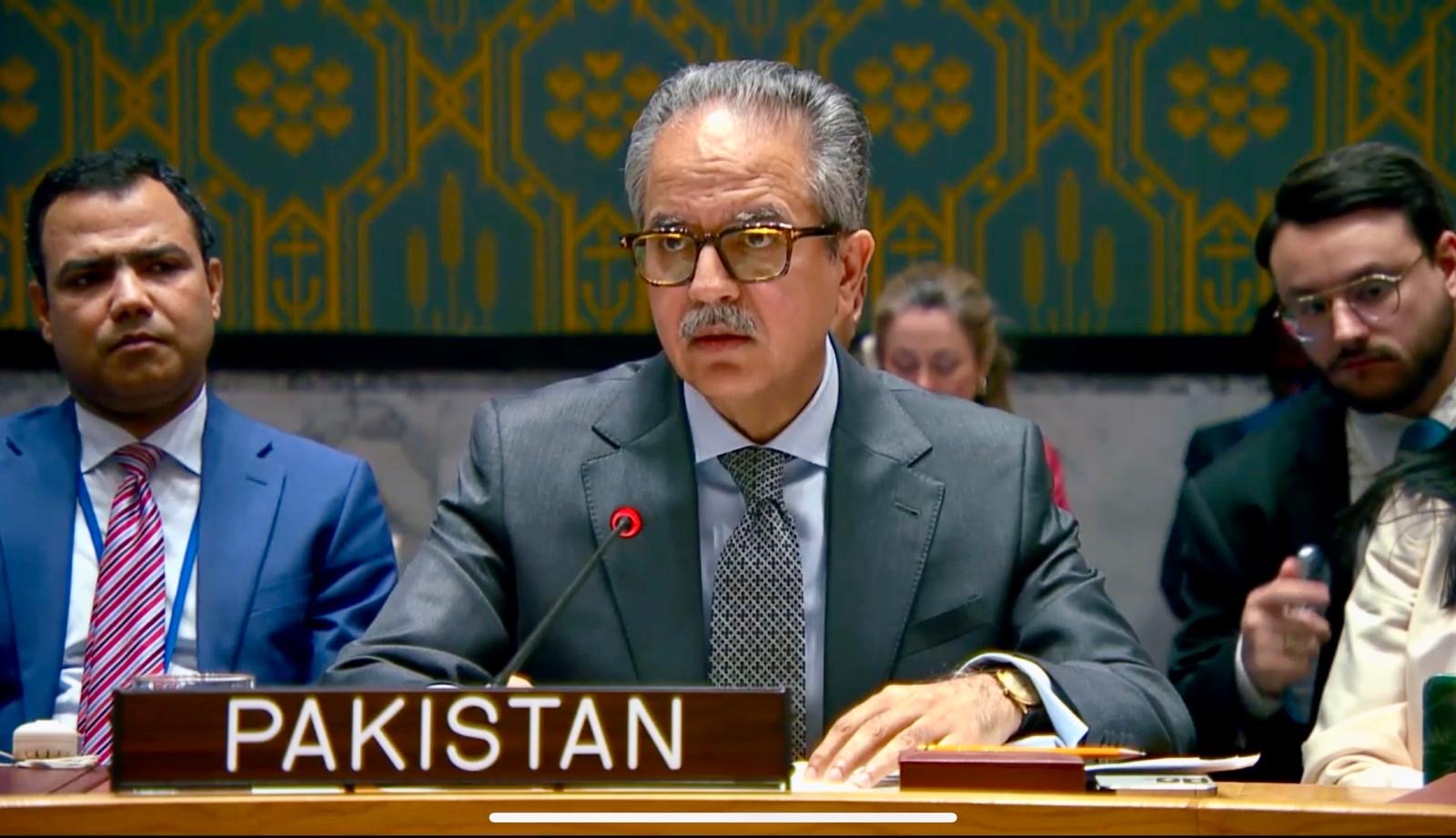
Newyork, 05 August 2026(Kamran Raja):Delivering Pakistan’s statement, Ambassador Asim Iftikhar Ahmad, Permanent Representative of Pakistan to the United Nations, welcomed the Secretary-General’s 23rd report on the threat posed by ISIL (Da’esh), noting that while sustained international efforts have weakened the group’s capabilities, its affiliates continue to demonstrate resilience and adaptability across Africa, the Middle East and Afghanistan.
The Ambassador highlighted that effective counter-terrorism operations by Pakistan have inflicted significant setbacks on ISIL-K. However, he cautioned that the group continues to pose a serious threat, particularly from within Afghanistan.
Emphasizing that terrorism cannot be defeated by any country acting alone, Pakistan underscored the importance of strengthening international cooperation, border management, law enforcement coordination and capacity-building. The statement also called for greater efforts to counter terrorists’ exploitation of emerging technologies, including unmanned aerial systems, information and communication technologies, social media platforms and artificial intelligence for recruitment, radicalization, financing and operational planning.
Pakistan further stressed the need to disrupt terrorist financing networks, including through digital wallets, virtual assets and cryptocurrencies, while preventing terrorist organizations from acquiring weapons, arms and ammunition that enhance their operational capabilities.
Expressing deep concern over the security situation in Afghanistan, Ambassador Ahmad noted that multiple terrorist organizations continue to operate from Afghan territory in an increasingly permissive environment. He stated that terrorist groups, including Tehreek-e-Taliban Pakistan (TTP), the Balochistan Liberation Army (BLA) and its Majeed Brigade, ISIL-K, ETIM and Al-Qaeda affiliates, maintain safe havens inside Afghanistan.
The Ambassador underscored that these groups continue to recruit, train, plan and launch terrorist attacks against Pakistan from Afghan territory. Referring to the recent suicide attack in Swat that claimed the lives of 16 Pakistanis, he urged the international community to effectively address the growing terrorist threat emanating from Afghanistan. He called on the Taliban authorities to fulfil their obligation to ensure that Afghan territory is not used to threaten or attack other States and stressed that external sponsors supporting, financing and arming terrorist proxies must also be held accountable.
Pakistan also emphasized that an effective international counter-terrorism strategy must address all forms and manifestations of terrorism, including state terrorism in situations of foreign occupation.
Marking the seventh anniversary of India’s unilateral actions of 5 August 2019 in Indian Illegally Occupied Jammu and Kashmir (IIOJK), Ambassador Ahmad described the continued repression in the territory as a grave violation of the rights of the Kashmiri people. He reiterated Pakistan’s position that the international community must demonstrate zero tolerance for state terrorism and cautioned against the misuse of counter-terrorism measures to suppress the legitimate struggle of peoples for self-determination under foreign occupation.
Looking ahead, Pakistan called for reforms to the United Nations counter-terrorism architecture and sanctions regimes to better address emerging threats and ensure that all terrorist groups posing a clear and present danger are effectively designated and sanctioned.
Concluding the statement, Ambassador Ahmad reaffirmed Pakistan’s unwavering commitment to the global fight against terrorism.
“Terrorism knows no borders; it has no religion; and it threatens all of humanity alike. A concerted, multilateral effort, aimed at advancing practical and solution-oriented approaches, remains the most effective way to comprehensively eradicate this scourge. Pakistan will remain a reliable partner in this collective endeavour,” he said.